'%20d='M0%203h96v1h-96z'/%3E%3Cpattern%20id='d1'%20width='2'%20height='2'%20patternUnits='userSpaceOnUse'%3E%3Cpath%20fill='%23e4b336'%20d='M0%200h1v1H0zM1%201h1v1H1z'/%3E%3C/pattern%3E%3Cpath%20fill='url(%23d1)'%20d='M0%207h96v1h-96z'/%3E%3Cpattern%20id='d2'%20width='2'%20height='2'%20patternUnits='userSpaceOnUse'%3E%3Cpath%20fill='%23d09d1b'%20d='M0%200h1v1H0zM1%201h1v1H1z'/%3E%3C/pattern%3E%3Cpath%20fill='url(%23d2)'%20d='M0%2011h96v1h-96z'/%3E%3Cpattern%20id='d3'%20width='2'%20height='2'%20patternUnits='userSpaceOnUse'%3E%3Cpath%20fill='%23ab821b'%20d='M0%200h1v1H0zM1%201h1v1H1z'/%3E%3C/pattern%3E%3Cpath%20fill='url(%23d3)'%20d='M0%2015h96v1h-96z'/%3E%3Cpath%20fill='%23FFFDFB'%20fill-opacity='.75'%20d='M1%207h1v1h-1zM57%205h1v1h-1zM18%201h1v1h-1zM28%206h1v1h-1zM76%205h1v1h-1zM36%206h1v1h-1zM56%202h1v1h-1zM29%203h1v1h-1zM17%201h1v1h-1zM3%202h1v1h-1zM38%208h1v1h-1zM94%203h1v1h-1zM15%206h1v1h-1zM4%203h1v1h-1zM47%204h1v1h-1zM62%203h1v1h-1z'/%3E%3Cpath%20fill='%2316151a'%20fill-opacity='.55'%20d='M63%205h1v1h-1zM64%205h1v1h-1zM65%205h1v1h-1zM66%205h1v1h-1zM67%205h1v1h-1zM63%206h1v1h-1zM67%206h1v1h-1zM68%206h1v1h-1zM63%207h1v1h-1zM68%207h1v1h-1zM63%208h1v1h-1zM65%208h1v1h-1zM66%208h1v1h-1zM68%208h1v1h-1zM63%209h1v1h-1zM68%209h1v1h-1zM63%2010h1v1h-1zM65%2010h1v1h-1zM66%2010h1v1h-1zM68%2010h1v1h-1zM63%2011h1v1h-1zM68%2011h1v1h-1zM63%2012h1v1h-1zM64%2012h1v1h-1zM65%2012h1v1h-1zM66%2012h1v1h-1zM67%2012h1v1h-1zM68%2012h1v1h-1z'/%3E%3Cpath%20fill='%23FFFDFB'%20d='M62%204h1v1h-1zM63%204h1v1h-1zM64%204h1v1h-1zM65%204h1v1h-1zM66%204h1v1h-1zM62%205h1v1h-1zM66%205h1v1h-1zM67%205h1v1h-1zM62%206h1v1h-1zM67%206h1v1h-1zM62%207h1v1h-1zM64%207h1v1h-1zM65%207h1v1h-1zM67%207h1v1h-1zM62%208h1v1h-1zM67%208h1v1h-1zM62%209h1v1h-1zM64%209h1v1h-1zM65%209h1v1h-1zM67%209h1v1h-1zM62%2010h1v1h-1zM67%2010h1v1h-1zM62%2011h1v1h-1zM63%2011h1v1h-1zM64%2011h1v1h-1zM65%2011h1v1h-1zM66%2011h1v1h-1zM67%2011h1v1h-1z'/%3E%3Cpath%20fill='%234f3e1a'%20d='M0%2019h7v3h-7zM7%2018h4v4h-4zM11%2016h7v6h-7zM18%2018h6v4h-6zM24%2018h5v4h-5zM29%2018h4v4h-4zM33%2018h6v4h-6zM39%2016h7v6h-7zM46%2018h3v4h-3zM49%2017h4v5h-4zM53%2014h4v8h-4zM57%2016h4v6h-4zM61%2016h6v6h-6zM67%2014h7v8h-7zM74%2014h6v8h-6zM80%2019h3v3h-3zM83%2016h5v6h-5zM88%2015h5v7h-5zM93%2017h5v5h-5z'/%3E%3Cpath%20fill='%23F4C533'%20d='M5%2020h1v1h-1zM16%2021h1v1h-1zM19%2020h1v1h-1zM30%2021h1v1h-1zM36%2021h1v1h-1zM36%2019h1v1h-1zM41%2020h1v1h-1zM44%2020h1v1h-1zM47%2021h1v1h-1zM51%2019h1v1h-1zM50%2019h1v1h-1zM54%2018h1v1h-1zM58%2017h1v1h-1zM62%2020h1v1h-1zM75%2017h1v1h-1zM81%2020h1v1h-1zM81%2021h1v1h-1zM90%2018h1v1h-1zM96%2019h1v1h-1zM95%2021h1v1h-1z'/%3E%3C/svg%3E)
In short
On 3 June 2026, Google launched two generative AI performance reports in Search Console, one for Search (AI Overviews and AI Mode) and one for Discover. You get impressions, pages, countries, devices and dates, with no clicks, no queries and no API access. Data history starts on 18 May 2026, and since 31 August 2026 the report is open to every site. In France, AI Overviews and AI Mode went live on 22 July 2026, so French AI impression curves start from zero right now.
New
What Google shipped on 3 June 2026
On 3 June 2026, Google published an announcement on the Search Central blog signed by Hillel Maoz, Search ecosystem engineering lead, and Moshe Samet, Search Console product lead. Two reports arrived, one for Search and one for Discover.
The Search report covers two surfaces, AI Overviews and AI Mode. One point deserves to be stated upfront, because it changes how you read your curves. Those impressions were already counted in the classic Performance report. What is new is the dedicated view, not the data.
Google says it plainly. Generative AI data "is included in the overall performance report, where it will continue to be tracked to give site owners a view of their overall visibility in Google Search."
The rollout started with a subset of sites, giving Google time to test and collect feedback. Here are the five pieces of information the new reports provide.
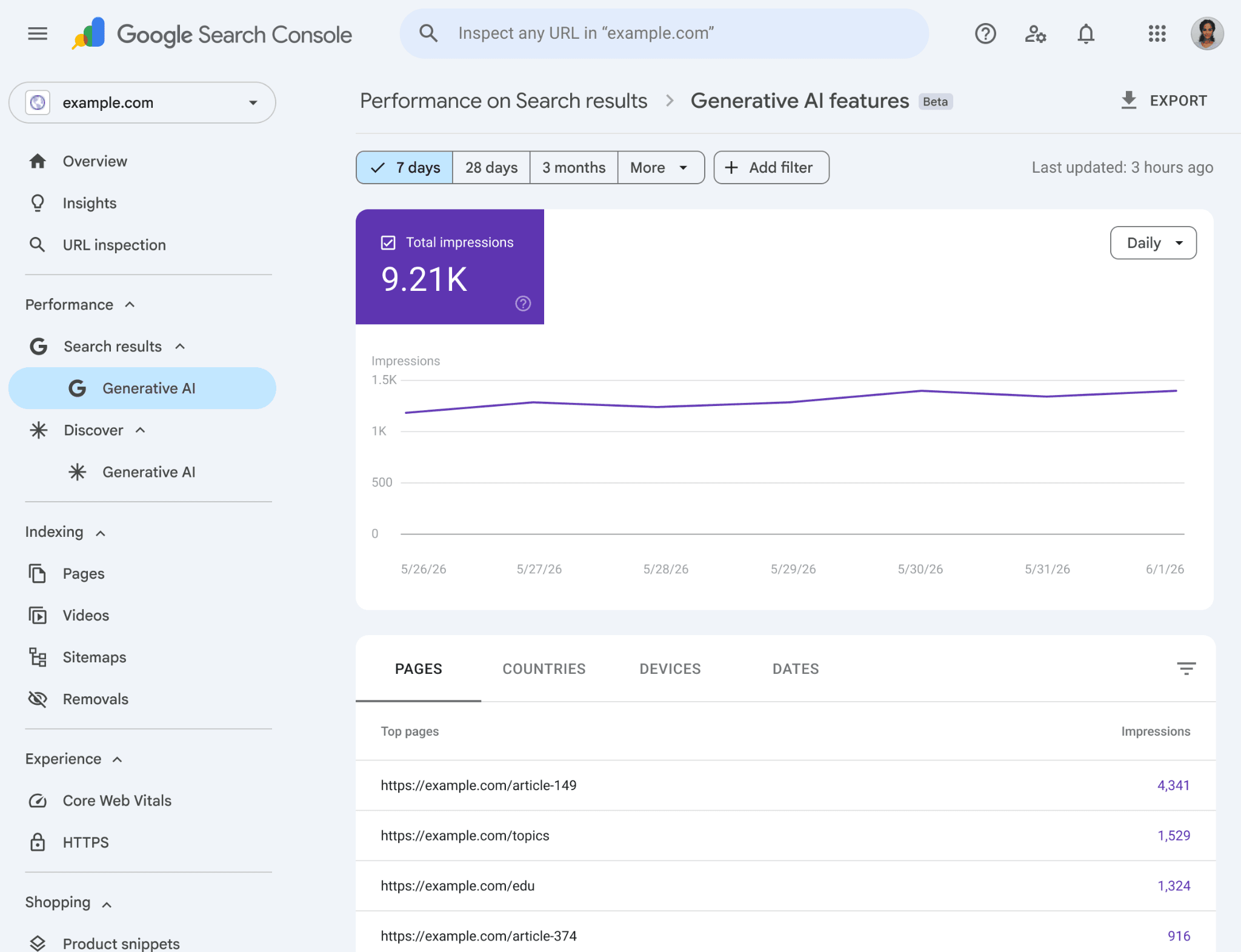
- Impressions, how often URLs from your site appeared in generative AI features.
- Pages, which URLs actually appeared inside those features.
- Countries, to understand your visibility market by market.
- Devices, desktop, mobile or tablet, available for Search only.
- Dates, with hourly, daily, weekly and monthly granularity.
Data
The 5 metrics you get and the 6 you do not
The list of missing metrics is more instructive than the list of available ones. It tells you exactly what you can steer here, and what you still have to measure elsewhere.
| Metric | Available | Detail |
|---|---|---|
| Impressions | Yes | How often a link to your site is shown in an AI feature |
| Pages | Yes | Final URL after redirects, assigned to the canonical URL |
| Countries | Yes | Country where the search originated |
| Devices | Yes | Desktop, mobile, tablet, Search only |
| Dates | Yes | Hourly, daily, weekly and monthly granularity |
| Clicks and CTR | No | Google plans more metrics over time, with no timeline |
| Queries | No | No keyword breakdown at all, not even partial |
| Position | No | Absent from the generative AI report |
| AI Overviews vs AI Mode | No | A single curve aggregates both surfaces |
| API and BigQuery | No | The type field of searchanalytics.query still accepts web, image, video, news, discover and googleNews |
| Search Labs | No | Google excludes experiments still in active development |
Counting
How Google counts an impression in AI Overviews and AI Mode
The counting rules are documented, rarely quoted, and they explain most of the gaps you will see between your tools and Search Console.
- An impression fires when a link to your site is shown. Links hidden behind an expandable element only count once the user expands them.
- A brand mention with no link generates no impression. The recommendation exists for the user, it does not exist for Search Console.
- Aggregation happens at property level. Two results from your site in the same answer count as a single impression.
- An AI Overview occupies a single position in the results page, and every link inside it inherits that position.
- In AI Mode, each follow-up question counts as a new search with its own metrics.
- A click on an external link from an AI Overview or AI Mode does count as a click, but it lands in the overall Performance report, never in the generative AI report.
- The freshest data is preliminary, shown as a dotted line, and can change within hours.
Search Console Help, impressions and clicks | Search Console Help, generative AI report
Timeline
Rollout timeline, from May 2024 to July 2026
Tracking of Google AI surfaces was built in three stages, an invisible phase, an aggregated phase, then the dedicated view of June 2026. The table below places the milestones that matter for measurement.
| Date | Event | Effect on measurement |
|---|---|---|
| May 2024 | AI Overviews launch in the United States | Impressions blended into the Web search type, no marker |
| 16 June 2025 | AI Mode data enters the Performance report | Extra volume, still no dedicated breakdown |
| 21 August 2025 | AI Mode expands to more than 180 countries in English | The AI share grows without being identifiable |
| 18 May 2026 | First data date in the generative AI report | No prior history, year over year comparison has to wait |
| 19 May 2026 | Google I/O, AI Mode passes 1 billion monthly users and AI Overviews 2.5 billion | The surface gets too large to stay unmeasured |
| 3 June 2026 | Generative AI reports and the Search generative AI control launch | Rollout starts in the United Kingdom |
| 23 June 2026 | Access extends to sites in the US, India and Switzerland | John Mueller describes an incremental rollout, with no general availability date |
| 29 June 2026 | Google letter to French press publishers | Arrival announced by 23 September 2026 at the latest, eventually pulled forward by two months |
| 22 July 2026 | AI Overviews and AI Mode go live in France | French AI impressions start from zero, with a gradual rollout spread over a few days |
| 31 August 2026 | AI reports and the Search generative AI control open to every site | Google says it rolled these insights out worldwide, while keeping a caveat for sites with low AI impression volume |
| Coming | More metrics added over time, including clicks | No announced date, and still no API access |
Search Engine Land, 23 June 2026 | Search Engine Land, 31 August 2026 | Search Engine Land, 16 June 2025
France
France, AI Overviews have been live since 22 July 2026
On the morning of 22 July 2026, Google switched on AI Overviews and AI Mode in France. The country was the last major market without either surface, two years after the US launch, because of the neighbouring rights dispute with press publishers. The rollout is gradual, on the web and in the iOS and Android apps, spread over a few days.
AI Mode arrives as a dedicated tab, next to Images, News and Videos. It takes text, voice and image input, handles follow-up questions, and runs on query fan out, the mechanism that splits one question into several concurrent searches. AI Overviews only trigger on queries Google systems consider complex enough.
The framework negotiated with publishers holds three commitments, and two of them describe exactly what Search Console had shipped seven weeks earlier.
- Control, every publisher can choose whether to appear in Google AI features, without losing its place in classic results.
- Transparency, the number of impressions generated by AI Overviews is reported separately from classic search results.
- Compensation, the neighbouring rights mechanism covering roughly 450 French publishers extends to content used by the AI engine, based on those AI impressions.
Traffic
What French organic traffic should expect
Two years of hindsight on other markets give an idea of the step ahead, even if no foreign figure transfers as is to a French site. Published measurements agree on the direction, and disagree on the magnitude depending on market, sector and query type.
- In the United Kingdom, Authoritas measures a 47.5 % click rate drop on desktop and 37.7 % on mobile when an AI Overview sits at the top of the page.
- In Germany, Sistrix reports 25 to 30 % erosion on first page links.
- Google answers that its engine still sends billions of clicks per day to the web, and points out that AI Overviews pass 2 billion monthly users across more than 200 countries.
- Opting out of AI features does not protect traffic, it only removes your content from generated answers, forfeiting the impressions and the compensation attached to them.
Analysis
Why this report becomes an accounting document in France
Nobody connects the two announcements, yet the link is obvious once you place them side by side. Beyond the marketing dashboard, the generative AI report lays down the measurement infrastructure that will support the discussion on compensation for content used in AI answers, since Google promises publishers separately counted AI impressions.
For a French site, that produces two very concrete consequences. Your AI impression curve starts at zero on 22 July 2026, with no prior baseline on the French market. And the first weeks blend two effects this report cannot separate, the ramp up of the rollout and your actual visibility.
The operational conclusion is simple, and the clock has started. Build an AI visibility history outside Search Console, otherwise you will discover your exposure at the exact moment it is too late to fix it.
Control
The Search generative AI control almost nobody noticed
Google shipped a setting called Search generative AI at the same time, available from Search Console settings, or directly at search.google.com/search-console/settings/search-gen-ai.
Two options exist, include or exclude, with inheritance from a parent property. Include is the default. Exclude prevents your content from being visible and linked inside AI Overviews, AI Mode and generative AI features in Discover. Google states that this control is not used as a ranking or inclusion signal in the rest of Search, so your organic positions are not affected.
One detail slipped under the radar and deserves attention. Google official AI optimization guide states that a site must be included in Search generative AI features in Search Console to be eligible for display in generative AI features. The setting is no longer a convenience, it is an eligibility requirement, on par with indexing and snippet permission.
- Check the setting before concluding you have no AI visibility, an exclusion inherited from a parent property is enough to empty the report.
- Allow one to two days for an exclusion to take effect, sometimes longer because of caching.
- An exclusion does not hide your content from classic search results, it only acts on generative surfaces.
Search Console Help, Search generative AI control | Google, generative AI optimization guide
Blind spots
Six blind spots other articles forget
- The report adds no new data. Your AI impressions were already counted in the Web type, so your totals do not move. What changes is segmentation, not volume.
- History starts on 18 May 2026 according to the first published observations. No year over year comparison is possible before May 2027.
- Nothing comes out through the API. The type field of searchanalytics.query has not changed and no BigQuery export exists. Manual CSV export is the only way out, so no automated Looker Studio.
- AI Overviews and AI Mode are merged into one curve. The former sits above the blue links, the latter is a conversational interface with query fan out. Two very different behaviours, one metric.
- The 1,000 row cap and property level aggregation crush the long tail. On a large site, the list of cited pages is truncated well before it becomes useful.
- Brands cited without a link do not exist in this report. Yet in a conversational answer, link free recommendation is common, and it is often what triggers a branded search afterwards.
Method
How to use the report in 6 steps
The report stays useful if you know what to do with it. Here is the routine we run on properties that already have access.
- Open Performance then the generative AI report. If the entry is missing from the menu, append /ai to your Performance report URL, the same trick works for Discover.
- Compute your AI share of impressions by dividing AI report impressions by your total Web impressions over the same period. On a large UK site observed in early June 2026, the ratio hovered around 10 % over 7 days.
- Rank your pages by AI impressions, then cross them with your conversions. The pages that feed answers are not always the ones that sell, and that gap is your first project.
- Filter by country to track France day by day since 22 July 2026, and compare its AI impression share with markets exposed for two years. The gap shows the ramp up still ahead.
- Export the CSV every week and store it. With no API, you are your own historical database.
- Check the Search generative AI setting and the technical eligibility of your pages, indexing and snippet permission, before blaming your content.
Official docs
What Google itself says about AI optimization
Google now publishes an official guide to optimizing for generative AI features. It corrects several market beliefs, and it is worth reading before buying a GEO method from anyone.
Google describes two mechanisms. Retrieval augmented generation, also called grounding, relies on core Search ranking systems to retrieve relevant, up to date pages. Query fan out issues a set of concurrent related searches to cover the subtopics of a single question.
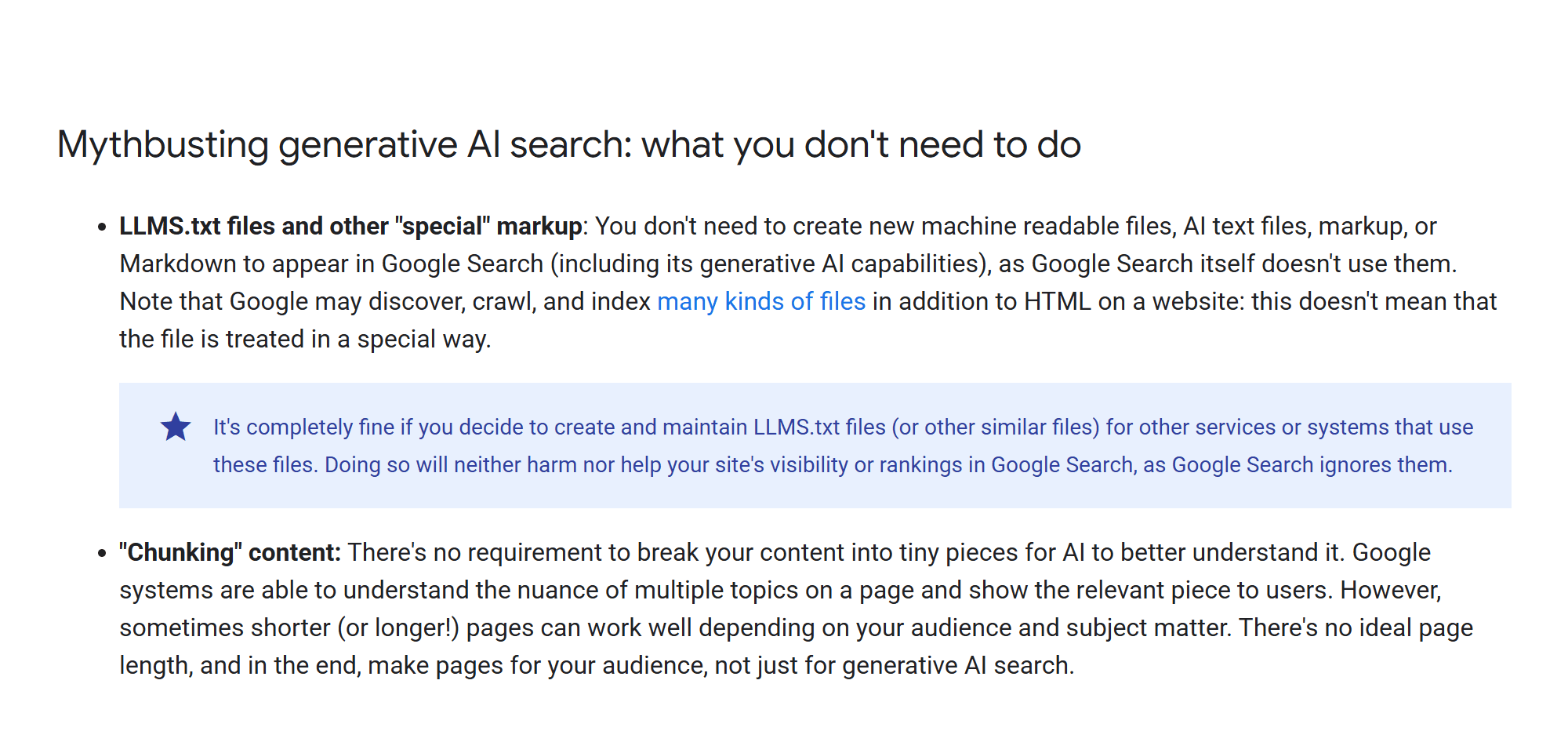
- llms.txt files and other special markup are ignored by Google Search, they neither harm nor help rankings.
- Chunking content into tiny pieces is not required, and there is no ideal page length.
- Structured data is not required for generative AI search, no dedicated schema.org markup exists, although markup still helps rich results.
- Rewriting content specifically for models is pointless, systems understand synonyms and close intents.
- Chasing inauthentic mentions across the web is less useful than it seems, spam systems apply to generative features too.
Limits
What Search Console will never see
Google adds a warning about third party tools, none of them has access to its internal ranking or AI systems. That is accurate, and it deserves a nuance. A serious AI visibility tool does not claim to read Google internals, it queries answer engines the way a user would and measures what comes out. That is observation, not privileged access.
The nuance becomes decisive as soon as you step outside the Google ecosystem. ChatGPT, Perplexity, Claude, Copilot and the Gemini app will never show up in Search Console, while a growing share of brand discovery happens there.
Add the attribution problem. Many visits coming from AI answers arrive with no referrer and end up bucketed as direct traffic in GA4. So you carry a blind spot on impressions and a blind spot on traffic.
- Search Console for Google surfaces, with impressions and nothing else.
- Bing Webmaster Tools for Bing and Copilot, with citation tracking.
- An AI visibility platform for ChatGPT, Perplexity, Claude and Gemini, with prompts, mentions, citations and share of voice.
Frequently asked questions
Where do I find the generative AI report in Search Console?
Inside the Performance section, below the Search results report. If the entry has not appeared yet, append /ai to your Performance report URL, the same trick works for Discover.
Why is the generative AI report missing for my site?
Three possible reasons. The rollout is still incremental, your site does not have enough impressions in AI features, or your property is excluded through the Search generative AI setting.
Does the report show clicks from AI Overviews?
No. The report is limited to impressions. Clicks from an AI Overview or AI Mode are counted, but only inside the overall Performance report, with no surface breakdown.
Do AI impressions add to my Web impressions?
No. They were already included in the Web search type of the Performance report. The generative AI report is a segmented view, your totals stay the same.
Can I separate AI Overviews from AI Mode?
Not today. Both surfaces are aggregated into a single curve. Google says more metrics will be added over time, with no announced timeline.
How do I exclude my site from Google AI features?
Through the Search generative AI setting in Search Console settings. Exclusion takes one to two days and does not affect your positions in classic search results.
Since when are AI Overviews and AI Mode live in France?
Since 22 July 2026, with a gradual rollout spread over a few days, on the web and in the mobile apps. Publishers keep an inclusion control and AI impressions are counted separately.
Will my generative AI report finally fill up now that France is live?
Gradually, under two conditions. Your property must have access to the report, whose rollout is still incremental, and your site must generate enough impressions in AI surfaces. The first days mostly reflect the ramp up of the French launch.
Is the report available through the Search Console API?
No. The type field of searchanalytics.query still accepts the same values and no BigQuery export exists. Manual CSV export is the only way to keep a history.
How do I track my visibility on ChatGPT and Perplexity?
With an AI visibility platform that queries those engines on your strategic prompts and measures your mentions, citations and share of voice. Search Console only covers Google surfaces.
Conclusion
The generative AI report is a real step forward, as long as you know what it is. It segments impressions that were already counted, on Google surfaces only, with no clicks, no queries and no API, on a history starting 18 May 2026.
For a French site, the question is no longer when AI surfaces will arrive. They have been live since 22 July 2026, and your visibility history starts now. Build it outside Search Console, then track in parallel the engines Google will never measure. Start with a free audit, define your strategic prompts, then set up weekly tracking of your mentions and share of voice.
Sources
- 1Maoz H., Samet M. Introducing Search generative AI performance reports in Search Console. Google Search Central Blog, 3 juin 2026
- 2Google Generative AI performance report (Search). Search Console Help, 2026
- 3Google Generative AI performance report (Discover). Search Console Help, 2026
- 4Google Search generative AI control. Search Console Help, 2026
- 5Google Optimizing your website for generative AI features on Google Search. Google Search Central, 2026
- 6Google AI features and your website. Google Search Central, 2026
- 7Google What are impressions, position, and clicks?. Search Console Help, 2026
- 8Clark B. Live Preview, Google Search Console AI Report and Controls. Brodie Clark Consulting, juin 2026
- 9Schwartz B. Google Search Console AI performance reports rolling out to more users. Search Engine Land, 23 juin 2026
- 10Search Engine Land Google AI Mode traffic data comes to Search Console. Search Engine Land, 16 juin 2025
- 11Abondance Google lance officiellement les AI Overviews en France. Abondance, 22 juillet 2026
- 12Blog du Modérateur Google déploie AI Overviews et AI Mode en France. Blog du Modérateur, 22 juillet 2026
- 13Abondance Les Google AI Overviews arrivent en France cet été. Abondance, 30 juin 2026
- 14Journal du Net Google va déployer AI Mode et AI Overviews sur son moteur de recherche en France durant l'été 2026. Journal du Net, 30 juin 2026
- 15CNBC Pichai, AI Overviews now has over 2.5 billion monthly users. CNBC, 19 mai 2026

'%20d='M0%204h48v1h-48z'/%3E%3Cpattern%20id='d1'%20width='2'%20height='2'%20patternUnits='userSpaceOnUse'%3E%3Cpath%20fill='%23e0a91c'%20d='M0%200h1v1H0zM1%201h1v1H1z'/%3E%3C/pattern%3E%3Cpath%20fill='url(%23d1)'%20d='M0%209h48v1h-48z'/%3E%3Cpattern%20id='d2'%20width='2'%20height='2'%20patternUnits='userSpaceOnUse'%3E%3Cpath%20fill='%23b88c1b'%20d='M0%200h1v1H0zM1%201h1v1H1z'/%3E%3C/pattern%3E%3Cpath%20fill='url(%23d2)'%20d='M0%2014h48v1h-48z'/%3E%3Cpattern%20id='d3'%20width='2'%20height='2'%20patternUnits='userSpaceOnUse'%3E%3Cpath%20fill='%2394711b'%20d='M0%200h1v1H0zM1%201h1v1H1z'/%3E%3C/pattern%3E%3Cpath%20fill='url(%23d3)'%20d='M0%2019h48v1h-48z'/%3E%3Cpath%20fill='%23FFFDFB'%20fill-opacity='.75'%20d='M28%206h1v1h-1zM22%209h1v1h-1zM18%202h1v1h-1zM22%208h1v1h-1zM10%206h1v1h-1zM13%201h1v1h-1zM9%201h1v1h-1zM18%200h1v1h-1zM24%201h1v1h-1z'/%3E%3Cpath%20fill='%2316151a'%20fill-opacity='.55'%20d='M27%203h2v2h-2zM29%203h2v2h-2zM31%203h2v2h-2zM33%203h2v2h-2zM35%203h2v2h-2zM27%205h2v2h-2zM35%205h2v2h-2zM37%205h2v2h-2zM27%207h2v2h-2zM37%207h2v2h-2zM27%209h2v2h-2zM31%209h2v2h-2zM33%209h2v2h-2zM37%209h2v2h-2zM27%2011h2v2h-2zM37%2011h2v2h-2zM27%2013h2v2h-2zM31%2013h2v2h-2zM33%2013h2v2h-2zM37%2013h2v2h-2zM27%2015h2v2h-2zM37%2015h2v2h-2zM27%2017h2v2h-2zM29%2017h2v2h-2zM31%2017h2v2h-2zM33%2017h2v2h-2zM35%2017h2v2h-2zM37%2017h2v2h-2z'/%3E%3Cpath%20fill='%23FFFDFB'%20d='M26%202h2v2h-2zM28%202h2v2h-2zM30%202h2v2h-2zM32%202h2v2h-2zM34%202h2v2h-2zM26%204h2v2h-2zM34%204h2v2h-2zM36%204h2v2h-2zM26%206h2v2h-2zM36%206h2v2h-2zM26%208h2v2h-2zM30%208h2v2h-2zM32%208h2v2h-2zM36%208h2v2h-2zM26%2010h2v2h-2zM36%2010h2v2h-2zM26%2012h2v2h-2zM30%2012h2v2h-2zM32%2012h2v2h-2zM36%2012h2v2h-2zM26%2014h2v2h-2zM36%2014h2v2h-2zM26%2016h2v2h-2zM28%2016h2v2h-2zM30%2016h2v2h-2zM32%2016h2v2h-2zM34%2016h2v2h-2zM36%2016h2v2h-2z'/%3E%3Cpath%20fill='%234f3e1a'%20d='M0%2020h3v7h-3zM3%2020h6v7h-6zM9%2024h4v3h-4zM13%2019h7v8h-7zM20%2021h3v6h-3zM23%2019h5v8h-5zM28%2023h6v4h-6zM34%2020h4v7h-4zM38%2023h3v4h-3zM41%2022h5v5h-5zM46%2024h6v3h-6z'/%3E%3Cpath%20fill='%23F4C533'%20d='M1%2025h1v1h-1zM11%2025h1v1h-1zM17%2024h1v1h-1zM17%2023h1v1h-1zM36%2023h1v1h-1zM36%2024h1v1h-1zM43%2024h1v1h-1zM42%2023h1v1h-1zM50%2026h1v1h-1z'/%3E%3C/svg%3E)
'%20d='M0%204h48v1h-48z'/%3E%3Cpattern%20id='d1'%20width='2'%20height='2'%20patternUnits='userSpaceOnUse'%3E%3Cpath%20fill='%23e2ae2a'%20d='M0%200h1v1H0zM1%201h1v1H1z'/%3E%3C/pattern%3E%3Cpath%20fill='url(%23d1)'%20d='M0%209h48v1h-48z'/%3E%3Cpattern%20id='d2'%20width='2'%20height='2'%20patternUnits='userSpaceOnUse'%3E%3Cpath%20fill='%23c5951b'%20d='M0%200h1v1H0zM1%201h1v1H1z'/%3E%3C/pattern%3E%3Cpath%20fill='url(%23d2)'%20d='M0%2014h48v1h-48z'/%3E%3Cpattern%20id='d3'%20width='2'%20height='2'%20patternUnits='userSpaceOnUse'%3E%3Cpath%20fill='%23a07a1b'%20d='M0%200h1v1H0zM1%201h1v1H1z'/%3E%3C/pattern%3E%3Cpath%20fill='url(%23d3)'%20d='M0%2019h48v1h-48z'/%3E%3Cpath%20fill='%23FFFDFB'%20fill-opacity='.75'%20d='M19%208h1v1h-1zM9%202h1v1h-1zM31%209h1v1h-1zM37%207h1v1h-1zM14%205h1v1h-1zM34%207h1v1h-1zM33%208h1v1h-1zM37%208h1v1h-1zM7%205h1v1h-1z'/%3E%3Cpath%20fill='%2316151a'%20fill-opacity='.55'%20d='M29%203h2v2h-2zM31%203h2v2h-2zM33%203h2v2h-2zM35%203h2v2h-2zM37%203h2v2h-2zM29%205h2v2h-2zM37%205h2v2h-2zM39%205h2v2h-2zM29%207h2v2h-2zM39%207h2v2h-2zM29%209h2v2h-2zM33%209h2v2h-2zM35%209h2v2h-2zM39%209h2v2h-2zM29%2011h2v2h-2zM39%2011h2v2h-2zM29%2013h2v2h-2zM33%2013h2v2h-2zM35%2013h2v2h-2zM39%2013h2v2h-2zM29%2015h2v2h-2zM39%2015h2v2h-2zM29%2017h2v2h-2zM31%2017h2v2h-2zM33%2017h2v2h-2zM35%2017h2v2h-2zM37%2017h2v2h-2zM39%2017h2v2h-2z'/%3E%3Cpath%20fill='%23FFFDFB'%20d='M28%202h2v2h-2zM30%202h2v2h-2zM32%202h2v2h-2zM34%202h2v2h-2zM36%202h2v2h-2zM28%204h2v2h-2zM36%204h2v2h-2zM38%204h2v2h-2zM28%206h2v2h-2zM38%206h2v2h-2zM28%208h2v2h-2zM32%208h2v2h-2zM34%208h2v2h-2zM38%208h2v2h-2zM28%2010h2v2h-2zM38%2010h2v2h-2zM28%2012h2v2h-2zM32%2012h2v2h-2zM34%2012h2v2h-2zM38%2012h2v2h-2zM28%2014h2v2h-2zM38%2014h2v2h-2zM28%2016h2v2h-2zM30%2016h2v2h-2zM32%2016h2v2h-2zM34%2016h2v2h-2zM36%2016h2v2h-2zM38%2016h2v2h-2z'/%3E%3Cpath%20fill='%234f3e1a'%20d='M0%2021h4v6h-4zM4%2019h4v8h-4zM8%2024h6v3h-6zM14%2020h5v7h-5zM19%2021h6v6h-6zM25%2020h7v7h-7zM32%2024h4v3h-4zM36%2023h4v4h-4zM40%2021h5v6h-5zM45%2024h6v3h-6z'/%3E%3Cpath%20fill='%23F4C533'%20d='M2%2025h1v1h-1zM9%2026h1v1h-1zM17%2026h1v1h-1zM15%2024h1v1h-1zM28%2023h1v1h-1zM34%2025h1v1h-1zM38%2025h1v1h-1zM41%2026h1v1h-1z'/%3E%3C/svg%3E)
'%20d='M0%204h48v1h-48z'/%3E%3Cpattern%20id='d1'%20width='2'%20height='2'%20patternUnits='userSpaceOnUse'%3E%3Cpath%20fill='%23e5b53c'%20d='M0%200h1v1H0zM1%201h1v1H1z'/%3E%3C/pattern%3E%3Cpath%20fill='url(%23d1)'%20d='M0%209h48v1h-48z'/%3E%3Cpattern%20id='d2'%20width='2'%20height='2'%20patternUnits='userSpaceOnUse'%3E%3Cpath%20fill='%23d5a11b'%20d='M0%200h1v1H0zM1%201h1v1H1z'/%3E%3C/pattern%3E%3Cpath%20fill='url(%23d2)'%20d='M0%2014h48v1h-48z'/%3E%3Cpattern%20id='d3'%20width='2'%20height='2'%20patternUnits='userSpaceOnUse'%3E%3Cpath%20fill='%23b1861b'%20d='M0%200h1v1H0zM1%201h1v1H1z'/%3E%3C/pattern%3E%3Cpath%20fill='url(%23d3)'%20d='M0%2019h48v1h-48z'/%3E%3Cpath%20fill='%23FFFDFB'%20fill-opacity='.75'%20d='M5%208h1v1h-1zM20%202h1v1h-1zM19%206h1v1h-1zM28%207h1v1h-1zM43%209h1v1h-1zM35%202h1v1h-1zM18%203h1v1h-1zM10%205h1v1h-1zM38%203h1v1h-1z'/%3E%3Cpath%20fill='%2316151a'%20fill-opacity='.55'%20d='M9%203h2v2h-2zM11%203h2v2h-2zM13%203h2v2h-2zM15%203h2v2h-2zM17%203h2v2h-2zM9%205h2v2h-2zM17%205h2v2h-2zM19%205h2v2h-2zM9%207h2v2h-2zM19%207h2v2h-2zM9%209h2v2h-2zM13%209h2v2h-2zM15%209h2v2h-2zM19%209h2v2h-2zM9%2011h2v2h-2zM19%2011h2v2h-2zM9%2013h2v2h-2zM13%2013h2v2h-2zM15%2013h2v2h-2zM19%2013h2v2h-2zM9%2015h2v2h-2zM19%2015h2v2h-2zM9%2017h2v2h-2zM11%2017h2v2h-2zM13%2017h2v2h-2zM15%2017h2v2h-2zM17%2017h2v2h-2zM19%2017h2v2h-2z'/%3E%3Cpath%20fill='%23FFFDFB'%20d='M8%202h2v2h-2zM10%202h2v2h-2zM12%202h2v2h-2zM14%202h2v2h-2zM16%202h2v2h-2zM8%204h2v2h-2zM16%204h2v2h-2zM18%204h2v2h-2zM8%206h2v2h-2zM18%206h2v2h-2zM8%208h2v2h-2zM12%208h2v2h-2zM14%208h2v2h-2zM18%208h2v2h-2zM8%2010h2v2h-2zM18%2010h2v2h-2zM8%2012h2v2h-2zM12%2012h2v2h-2zM14%2012h2v2h-2zM18%2012h2v2h-2zM8%2014h2v2h-2zM18%2014h2v2h-2zM8%2016h2v2h-2zM10%2016h2v2h-2zM12%2016h2v2h-2zM14%2016h2v2h-2zM16%2016h2v2h-2zM18%2016h2v2h-2z'/%3E%3Cpath%20fill='%234f3e1a'%20d='M0%2021h4v6h-4zM4%2023h5v4h-5zM9%2023h3v4h-3zM12%2020h6v7h-6zM18%2022h4v5h-4zM22%2023h5v4h-5zM27%2024h4v3h-4zM31%2024h5v3h-5zM36%2024h7v3h-7zM43%2020h7v7h-7z'/%3E%3Cpath%20fill='%23F4C533'%20d='M1%2023h1v1h-1zM5%2026h1v1h-1zM10%2025h1v1h-1zM13%2025h1v1h-1zM19%2025h1v1h-1zM20%2023h1v1h-1zM23%2025h1v1h-1zM23%2025h1v1h-1zM28%2025h1v1h-1zM34%2026h1v1h-1zM33%2025h1v1h-1zM41%2025h1v1h-1zM45%2022h1v1h-1zM46%2021h1v1h-1z'/%3E%3C/svg%3E)