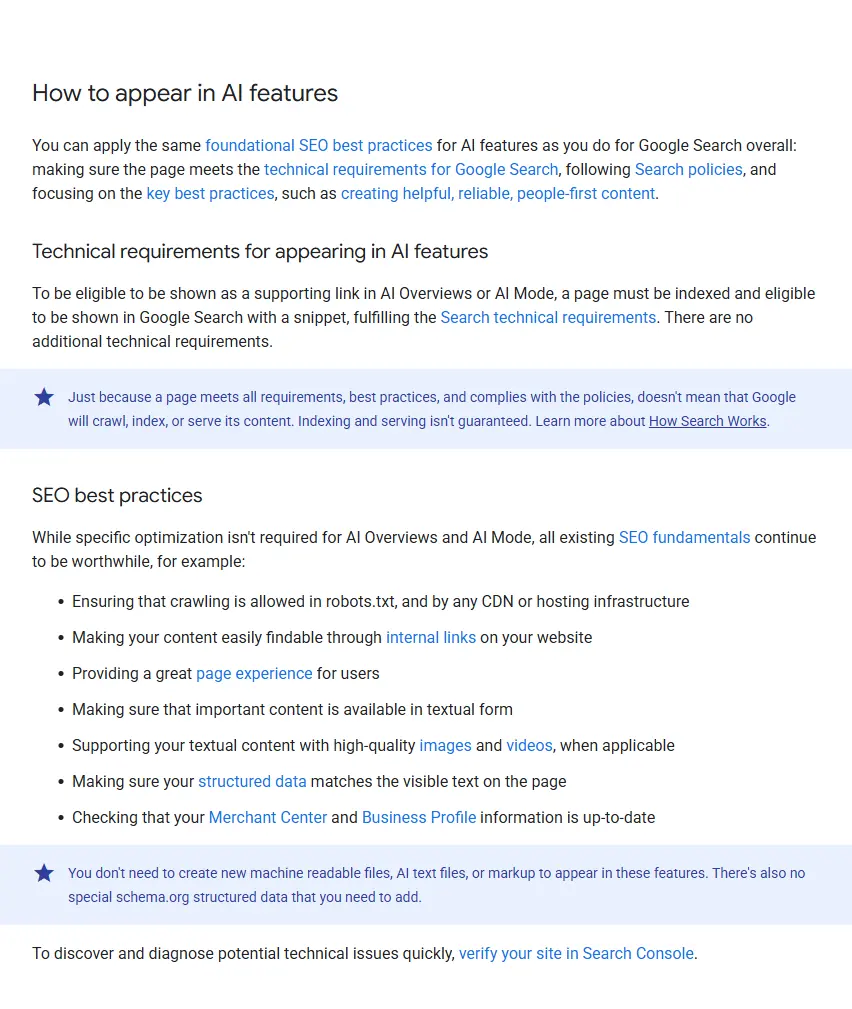
Three technical conditions make a page eligible for AI Overviews, being indexed, being eligible to show with a snippet, and staying included in the Search generative AI control in Search Console. Google states that no additional requirement or special optimization exists, and that no file or markup triggers an appearance. Beyond those conditions, fundamentals decide, original non-commodity content, crawling allowed, internal links, visible text, quality images, structured data that matches the page, and up-to-date Merchant Center and Business Profile details. None of this guarantees a citation, it only improves your odds.
Is there a tag that guarantees an appearance in AI Overviews?
No. Google states plainly that there are no additional requirements and no special optimizations needed to appear in AI Overviews or AI Mode. The documentation adds that you do not need to create machine readable files, AI text files, or markup, and that no dedicated schema.org structured data exists for these surfaces. Three technical conditions make a page eligible, being indexed, being eligible to be shown with a snippet, and meeting the Search technical requirements. Google then adds that meeting every requirement guarantees neither crawling, nor indexing, nor serving. On top of that, the documentation says AI Overviews only show when Google systems decide they add value over classic Search, which is why the very same page can be quoted one week and absent the next. Appearing in an AI Overview stays a probability you improve, never an outcome a tag buys.
That distinction shapes this whole guide. We keep what Google documents officially separate from what the market assumes. Official recommendations are verifiable and dated. GEO hypotheses can be useful, they remain hypotheses until Google confirms them, and we flag them as such.
We are publishing this guide now because the French rollout finally landed. Google switched AI Overviews and AI Mode on for google.fr on 22 July 2026, after two years during which France stayed the last large market on the sidelines. That is what makes the screenshots below possible, and it moves the subject from theory to daily operations for French-speaking sites. The eligibility rules themselves are the same everywhere, so this guide holds whatever market you sell to.
- No tag, no file and no content format forces an appearance in AI Overviews. Any method sold as guaranteed is false.
- A page can be perfectly optimized and never appear, because Google only shows an AI Overview when its systems decide it adds value over classic Search.
- Google explicitly warns against third-party tools that promise rankings or claim to use internal metrics. No third-party tool has access to its ranking or AI systems.
- AI Overviews and AI Mode may use different models, so they can return different answers and different links for the same query.
Google Search Central, AI features and your website | Google, guide to optimizing for generative AI features
AI Overviews, AI Mode and classic results, what is the difference?
AI Overviews appear above the blue links, on a results page that stays a results page. AI Mode is a separate conversational surface, built for questions that need reasoning or complex comparisons. Classic results keep running underneath both. Since 22 July 2026 both surfaces are live in France, the last large market to receive them.
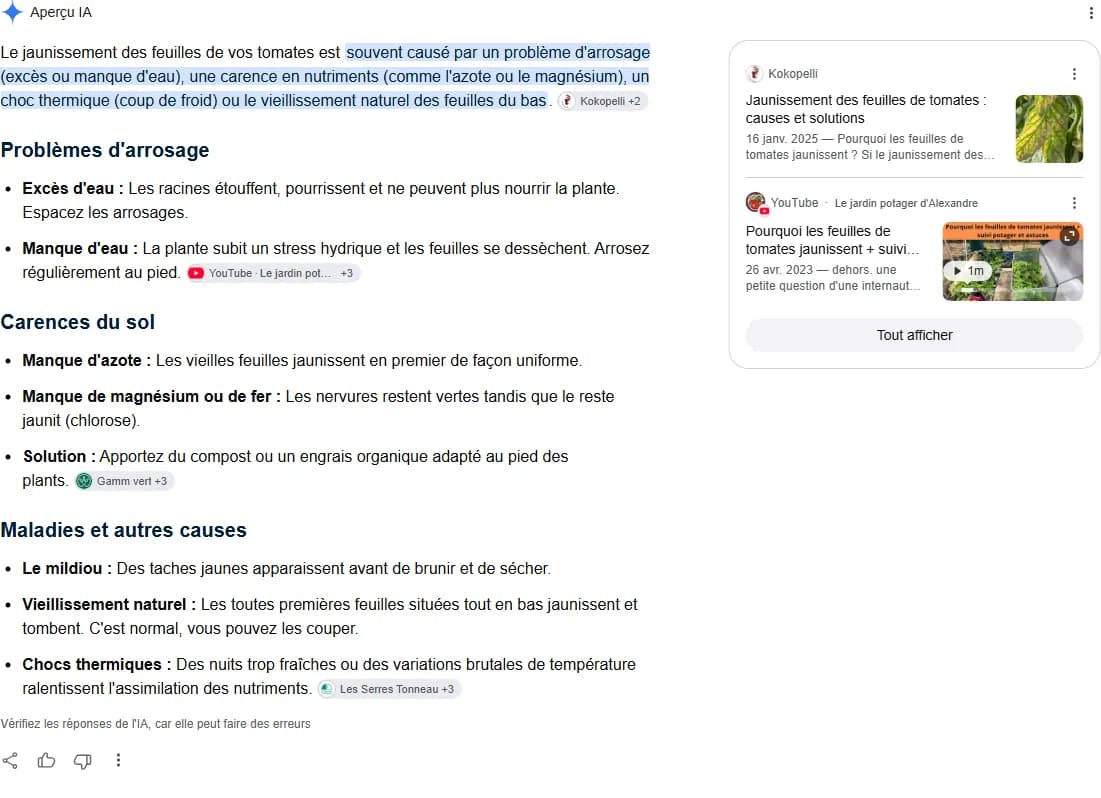
The screenshot below comes from a real search on google.fr. The AI Overview splits its answer into three themed blocks and attaches a clickable source chip to each one, backed by a card panel on the right. Citation surfaces are therefore spread along the text, sentence by sentence, rather than gathered in one link at the bottom.
| Surface | What the user sees | What it changes for you |
|---|---|---|
| Classic results | A list of blue links with title and snippet | Title and meta description keep their role, clicks follow your position |
| AI Overviews | A summary at the top, with source chips spread through the text | Any passage of your page can become a source, granularity drops to the paragraph |
| AI Mode | A conversation with follow-up questions and supporting links | One session covers several sub-questions, your page has to answer a precise angle |
Google Search Central, AI features and your website | Blog du Moderateur, AI Overviews and AI Mode rollout in France
Which technical prerequisites make a page eligible?
A page becomes eligible for AI Overviews once it meets three cumulative conditions. It must be indexed in Google Search. It must be eligible to show with a snippet, so it cannot carry nosnippet, max-snippet set to zero, or noindex. It must meet the Search technical requirements, meaning Googlebot is not blocked, the page returns an HTTP 200 status code, and the page has indexable content. Google adds a fourth condition specific to generative surfaces, the site must stay included in the Search generative AI control in Search Console. That control defaults to include, it is inherited from the closest parent property, and an exclusion takes effect within one to two days. It is not used as a ranking signal elsewhere in Search.
Inheritance is where teams get caught. An exclusion set on a domain property propagates to child properties, and nobody remembers it six months later. Before blaming your content, open the setting and read its actual value.
- Confirm the page is indexed with URL Inspection in Search Console, and that Google fetched the version you intend to serve.
- Inspect the HTML Googlebot received and look for robots meta tags. A nosnippet or max-snippet:0 value makes the page ineligible for AI Overviews while leaving it indexed.
- Check that data-nosnippet does not wrap the very passage you want quoted.
- Open Search Console Settings, then Search generative AI, and confirm the Include value, parent property included.
- Verify that robots.txt, the CDN and the firewall let Googlebot through. An infrastructure block produces the same symptoms as a markup mistake.
- Test rendering if your page depends on JavaScript, since content injected after load still has to be crawlable.
Google, Search technical requirements | Search Console, Search generative AI control
How do you write content that is useful and actually extractable?
Google states one simple and demanding rule, create non-commodity content that is helpful, reliable and people-first. Its documentation contrasts two telling examples. A piece titled "7 Tips for First-Time Homebuyers" is common knowledge and adds no value of its own. A piece titled "Why We Waived the Inspection & Saved Money, A Look Inside the Sewer Line" carries experience nobody else can copy.
The second lever is form. Important text has to exist as text, not only inside an image, a video or a client-rendered component. Headings and sections serve human reading, and that same structure helps systems isolate the passage that answers a precise question.
- Answer the main question in the first lines, then expand. A self-contained passage is easier to quote than a conclusion that depends on three earlier paragraphs.
- Bring a first-hand point of view, a test you ran, a number you measured, a method you actually apply.
- Keep important content as visible text in the served HTML, without depending on client rendering.
- Use headings that restate real questions, and keep paragraphs short.
- Make the page reachable through internal links from your strong pages, otherwise it stays hard to discover.
- Support the text with relevant images and videos, following Google image SEO best practices.
- Reduce duplicate content, which wastes crawl budget and dilutes the signal.
Google, creating helpful, reliable, people-first content | Google, image SEO best practices
Go further. Internal linking | Topical authority | How generative AI is transforming SEO
Authority and originality, what makes a source worth reusing
A retrieval-augmented generation system picks its sources from the pages Google ranking systems consider relevant and up to date. Topical authority is therefore built exactly where it was already built, through a coherent set of pages that covers a subject in depth rather than a single isolated article. Google stresses a point many content strategies ignore, a unique point of view carries more weight than a summary of what exists elsewhere, because its systems review several sources and look for what stands out. Publishing a synthesis of five competing articles produces content the model can already generate on its own. Publishing a test, a dataset, an applied method or a dated field report produces information the model has to come and get from you.
Originality alone is not enough. Google reminds site owners that its anti-spam systems apply to generative features too, and that seeking inauthentic mentions across the web helps less than it seems. What surfaces are real mentions in blogs, videos and forum discussions, the ones your product or your expertise genuinely triggers.
- Pick a scope you can cover better than anyone else, rather than a broad subject treated on the surface.
- Date and source your claims, and correct pages when reality changes.
- Sign your content with an identifiable author and a page that documents their experience.
- Link pages on the same subject together so the coverage reads as one body of work.
Query fan-out and RAG, what do these mechanisms change?
Google documents two mechanisms behind its generative features. Retrieval-augmented generation, also called grounding, relies on core Search ranking systems to retrieve relevant, up-to-date pages, then reviews the information on those pages to build the answer and the links shown with it. Query fan-out issues a set of concurrent related queries generated by the model. For "how to fix a lawn that is full of weeds", Google gives "best herbicides for lawns", "remove weeds without chemicals" and "how to prevent weeds in lawn" as example fan-out queries.
The temptation is immediate, ship one page per fan-out query. Google closes that door explicitly. Creating separate content for every variation, in particular by targeting fan-out queries, primarily to manipulate rankings or generative responses, falls under its scaled content abuse spam policy. Google adds that the strategy is ineffective long term, because its systems understand page relevance even without an exact match between query and content.
- Read fan-out as a map of sub-questions to cover inside one solid page, not as a list of URLs to generate.
- No public documentation reveals the fan-out queries actually issued for a given query. Any method claiming to reconstruct them produces a hypothesis, not Google data.
- More pages do not make a site more relevant, Google says so on the same documentation page.
Google, guide to optimizing for generative AI features | Google, scaled content abuse policy
Related resources. Prepare your site for AI agents | Track your citations with Spotlight
Structured data, images, Merchant Center and Business Profile
Google is clear about structured data. It is not required for generative AI search and there is no special schema.org markup to add. The documentation still sets a consistency requirement, your structured data has to match the visible text on the page. Markup that announces a price, a rating or a date absent from the page becomes an inconsistency, and markup otherwise stays useful for classic rich results.
For local businesses and commerce, the documentation names two concrete surfaces. Generative responses can include product listings, product information and information about local businesses. An up-to-date Merchant Center feed and a correct Business Profile therefore feed those answers directly, which makes them a priority for a retailer and a secondary concern for a software vendor.
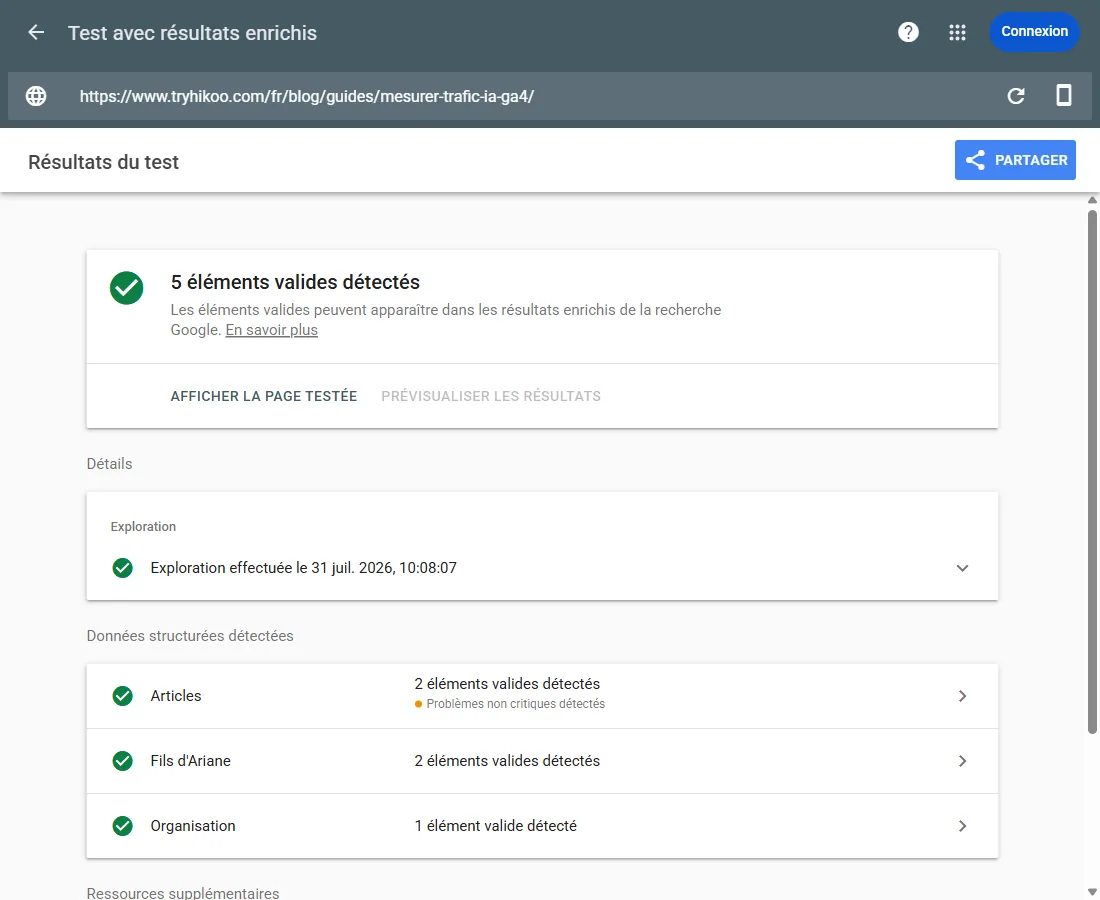
- Use the Rich Results Test to check syntax, then reread the page to confirm the markup describes what is actually displayed.
- A type missing from the report is not automatically an error, not every schema.org type produces a rich result.
- Treat Merchant Center and Business Profile as sources of truth, wrong opening hours end up inside a generated answer.
- Follow Google image best practices instead of adding decorative visuals unrelated to the text.
Google, establish your business details on Search | Google Search Central, AI features and your website
Related resources. Glossary, schema markup | Analyzer, page by page audit
Which GEO myths can you ignore on the Google side?
Google devotes a full section of its guide to dismantling tactics circulating online. The table below restates its wording and turns it into an operational decision. Mind the scope, these answers apply to Google Search. An llms.txt file can still matter for other systems that read it, Google only says it ignores the file and that its presence neither harms nor helps rankings.
| What the market says | What Google says | Decision |
|---|---|---|
| Publish an llms.txt to be seen by AI | Google Search ignores these files, they neither harm nor help rankings | Skip it for Google, evaluate it for other systems |
| Chunk content into tiny blocks | No chunking required, no ideal page length | Write for readers, size the page to the subject |
| Rewrite pages for the models | Systems understand synonyms and close intents | Invest in substance rather than rephrasing |
| Buy mentions across the web | Inauthentic mentions help less than it seems, anti-spam applies | Earn real mentions through product and proof |
| Add schema for the AI | Not required for generative AI, no dedicated markup | Keep markup for rich results, demand consistency |
Google, guide to optimizing for generative AI features | Google, evaluating third-party SEO advice
How do you know whether your pages feed the answers?
Google points to the generative AI performance report in Search Console to measure its own surfaces. That report gives aggregated impressions and clicks, without separating AI Overviews from AI Mode. We documented how it works and where it goes blind in a dedicated guide, which we do not repeat here.
Two limits are worth stating before you open a dashboard. Search Console only covers Google, so no ChatGPT, no Perplexity, no Claude. And a brand mentioned without a clicked link shows up in no traffic report, even though that mention often triggers the branded search that follows.
Search Console, generative AI performance report
Our measurement guides. Search Console generative AI report | Search Console for AI | Measure AI traffic in GA4
A 12-point checklist for a candidate page
This list covers technical eligibility first, then editorial value, in the order we run it on a real page. The first six points decide whether the page can be shown, the last six decide whether it deserves to be quoted over another one.
- The page is indexed and URL Inspection confirms the version served to Googlebot.
- No nosnippet, max-snippet:0 or noindex directive blocks the snippet.
- No data-nosnippet attribute wraps the passage you want quoted.
- The Search generative AI control in Search Console is set to Include, inheritance included.
- robots.txt, CDN and firewall let Googlebot through, and the page returns a 200 status code.
- Important content is present in the served HTML, without depending on client rendering.
- The answer to the main question arrives in the first lines of the page.
- The content brings experience, a test or data nobody else publishes.
- Headings restate real questions and split the subject in a readable way.
- Internal links from your strong pages make the page easy to reach.
- Images and videos serve the point and follow Google best practices.
- Structured data matches the visible text, and your Merchant Center and Business Profile details are current.
Useful tools. Check AI crawler access | Free AI visibility audit | Glossary, AI Overviews
Frequently asked questions
How long does it take to appear in an AI Overview after an update?
Google publishes no timeline. The only documented duration concerns the Search generative AI control, where an exclusion takes effect within one to two days, sometimes longer because of caching. For everything else the page has to be recrawled first, and Google says crawling can take from a few days to several months depending on how often its systems decide a page should be refreshed.
Does appearing in an AI Overview cost you traffic?
Google states that clicks from results pages containing an AI Overview are higher quality, with users more likely to spend time on the site. That claim comes from Google and cannot be verified from the outside. What you can measure on your own property is your click-through rate and your conversions per page, before and after the French rollout of 22 July 2026.
Can a site without Search Console appear in AI Overviews?
Yes. The Search generative AI control defaults to include, so a site that never opened a property stays eligible. Search Console is there to diagnose and measure, not to request permission. It becomes necessary as soon as you want to check an inherited exclusion or read the generative AI performance report.
Should you block Google-Extended to protect your content?
Google-Extended covers AI training and grounding in certain other Google systems, outside Search. Blocking it is therefore the wrong lever for AI Overviews. For those surfaces the nosnippet, data-nosnippet, max-snippet and noindex controls, together with the Search generative AI setting, are what actually apply.
Are French pages treated differently?
Google documentation describes no eligibility rule specific to a language or a country. The only French specificity was timing, since both surfaces launched on 22 July 2026 while other markets had them from 2024. In practice that mostly means a very short data history in your reports.
How do you check whether a page is blocked by a snippet directive?
Open URL Inspection in Search Console and read the HTML fetched by Googlebot, not the one in your browser. Look for the robots meta tag and X-Robots-Tag headers. A nosnippet or a max-snippet of zero leaves the page indexed and visible in blue links while making it ineligible for AI Overviews, which makes the symptom hard to spot without that check.
Can a very short page be cited?
Yes. Google states there is no ideal length and no required chunking. A short page that answers one precise question can work, and so can a long page on a subject that deserves it. The useful criterion stays reader satisfaction, not a word count.
What we take away
Eligibility for AI Overviews comes down to four technical checks and one editorial demand. The checks take an hour. The editorial demand, publishing what nobody else can publish, takes the rest of the year.
The next step is knowing where you actually stand. Our free audit checks crawler access, page structure and citability signals, and Analyzer then tracks page by page what feeds the answers of AI engines.
Sources
- Google AI features and your website. Google Search Central, mise à jour du 10 décembre 2025
- Google Optimizing your website for generative AI features on Google Search. Google Search Central, mise à jour du 10 juillet 2026
- Google Search Essentials, technical requirements. Google Search Central, mise à jour du 18 décembre 2025
- Google Search generative AI control. Search Console Help, 2026
- Google Generative AI performance report (Search). Search Console Help, 2026
- Google Robots meta tags, data-nosnippet and X-Robots-Tag specifications. Google Search Central, 2026
- Google Creating helpful, reliable, people-first content. Google Search Central, 2026
- Google Spam policies for Google web search, scaled content abuse. Google Search Central, 2026
- Google Image SEO best practices. Google Search Central, 2026
- Google Establish your business details on Google Search. Google Search Central, 2026
- Google How to evaluate third-party SEO advice and services. Google Search Central, 2026
- Google Google-Extended, controlling AI training and grounding. Google Search Central, 2026
- Abondance Google lance officiellement les AI Overviews en France. Abondance, 22 juillet 2026
- Blog du Modérateur Google déploie AI Overviews et AI Mode en France. Blog du Modérateur, 22 juillet 2026