Query fan-out describes a model generating several related queries before composing an answer. The term belongs to Google, the mechanism does not. OpenAI documents that ChatGPT rewrites your question into one or more targeted queries, then sends additional, more specific ones after reviewing the first results. Anthropic documents a search loop that can repeat multiple times within a single request, with 1 to 3 searches for a simple factual question and 10 or more for comparative research. Those subqueries can be read, ChatGPT, Claude and Perplexity display them, the Gemini API returns them, and only AI Mode and AI Overviews stay closed. On our own domain, a single prompt produced 126 distinct query variants. The useful work is therefore to log those queries, then rebuild a research plan from the buyer prompt, covering subtopics, criteria, entities, objections, alternatives, proof and freshness, to serve each sub-intent with the page that matches it.
What is query fan-out in SEO and GEO?
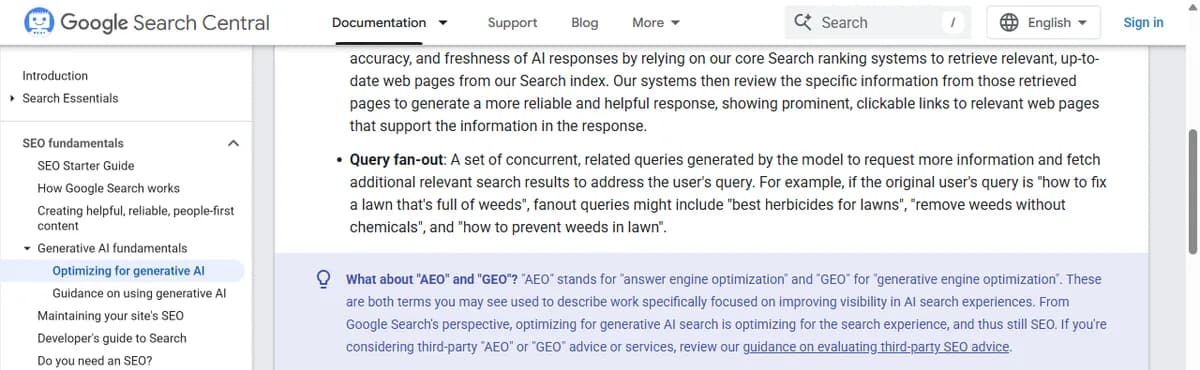
Query fan-out is a set of concurrent, related queries generated by the model to request more information and fetch additional relevant search results before answering. That is the definition Google publishes in its generative AI optimization guide, last updated in July 2026. The SEO consequence is immediate, one user question triggers several searches, so several different pages can feed the same answer. Google states elsewhere that the technique applies to AI Overviews as well as AI Mode, and that it supports greater link diversity than a traditional search. In practice, a page that only answers the head phrasing forfeits the subqueries deciding the rest of the response, while a set of pages covering each sub-intent multiplies the possible entry points into your site.
Google pairs that definition with a concrete example. If the original query is how to fix a lawn that is full of weeds, fanout queries might include "best herbicides for lawns", "remove weeds without chemicals" and "how to prevent weeds in lawn". Three sub-intents, three editorial angles, three pages that can each be cited, where classic SEO would have targeted a single head keyword.
One clarification matters immediately, because it changes the scope of this guide. The term query fan-out belongs to Google, the mechanism does not. OpenAI, Anthropic and Perplexity each document, in their own words, a model that writes its own queries to answer. We cover those documents further down with the exact wording. For now, note that a content plan built on this principle does not serve Google alone.
Query fan-out does not replace search optimization, it changes the unit of work. You no longer target one query and one page, you target a user question and the whole set of follow-up questions the model asks to answer it. Google makes the same point in its AEO and GEO callout, optimizing for generative AI search is optimizing the search experience, and therefore still SEO.
Google, generative AI optimization guide | Google, AI features and your website
Related concepts. Prompt intent | AI Overviews
What does a B2B SaaS buyer prompt look like in AI Mode?
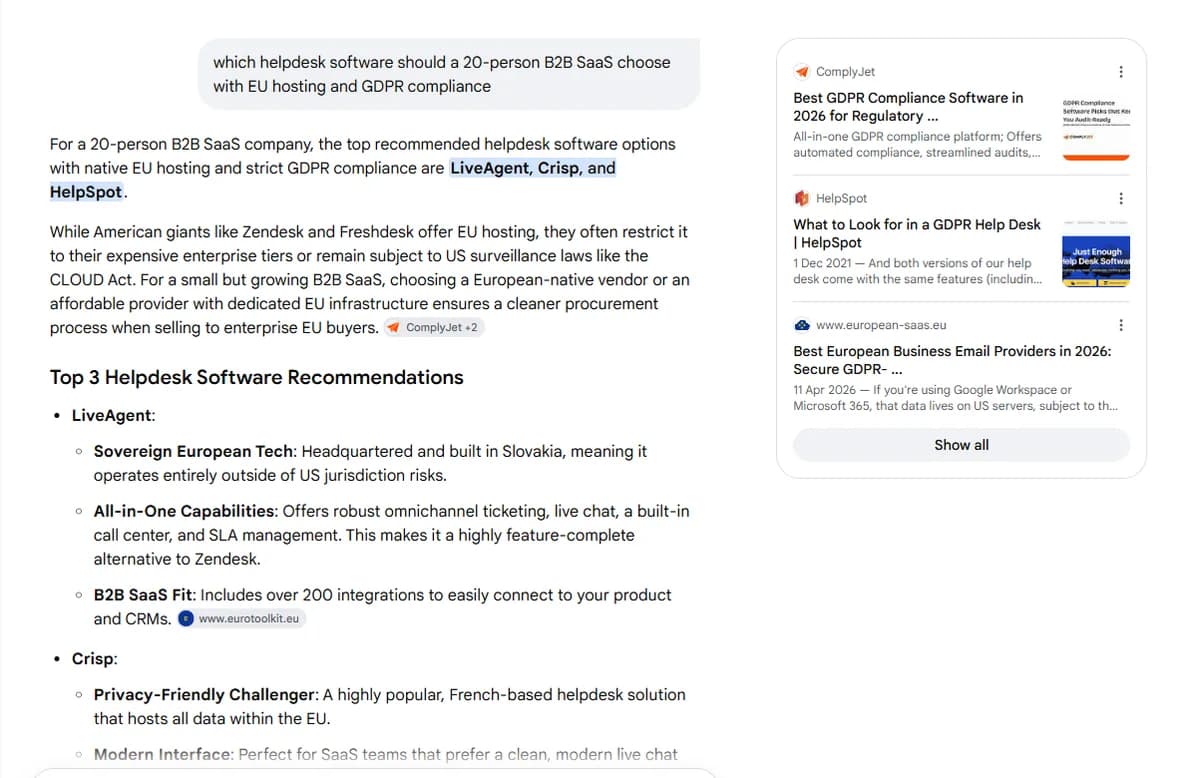
Start from a real buyer question rather than a keyword. We submitted this prompt to AI Mode, which helpdesk software should a 20-person B2B SaaS choose with EU hosting and GDPR compliance. That phrasing is representative of what buyers actually type today, a team size constraint, a geographic constraint, a regulatory constraint and a purchase decision, all in one sentence.
The answer is not a list of links. It is a structured document that answers several questions nobody asked out loud. It names three options in the opening lines, it separates European vendors from US vendors offering an EU region, it builds a comparison layer, then it closes on contractual checks to run before signing. Each of those blocks cites different sources.
What does the answer contain once we break it down?
Reading an AI Mode answer as an editorial plan is the highest-return exercise in this guide. Every mid-level heading maps to a sub-intent the model judged necessary, and every cited source maps to a page that covered that sub-intent better than the rest.
- A direct recommendation in the first paragraph, which assumes a page willing to decide rather than list.
- A split by vendor nature, European sovereignty on one side, EU region of a US vendor on the other.
- A comparison layer covering data residency, vendor jurisdiction and team fit.
- A contractual section on data processing agreements, deletion rights and access control, citing legal sources rather than product pages.
- A closing qualification question, a sign the model treats the exchange as a journey rather than an isolated query.
How do you turn a prompt into a research plan?
A buyer prompt always breaks down along the same seven axes. This grid does not claim to reproduce the internal queries Google fires, it reproduces the structure of the decision, which is enough to build a useful content plan. We apply it to the European helpdesk example, but it works for any B2B category.
Subtopics, criteria and entities
Subtopics are the blocks an answer must cover to be complete, for instance data residency, pricing model, functional depth and product integration. Criteria are the variables the buyer arbitrates on, and they become the columns of a comparison table. Entities are the proper nouns the model needs to connect, vendors, hosting providers, regulations and certifications.
- Subtopics, the blocks a complete answer needs, one per future H2.
- Criteria, the trade-off variables, they become your table columns.
- Entities, the proper nouns to name and connect, products, vendors, standards, jurisdictions.
Related concepts. Entity coverage | Topical authority
Objections, alternatives, proof and freshness
Objections are the reasons not to buy, and they often produce the most valuable subqueries because almost nobody answers them head on. Alternatives are the competing paths, including doing nothing or building something in-house. Proof is what makes a claim citable, a sourced number, a dated test, a screenshot, a documentation excerpt. Freshness is how long your answer stays true, a year for a method, a few months for a price or a feature.
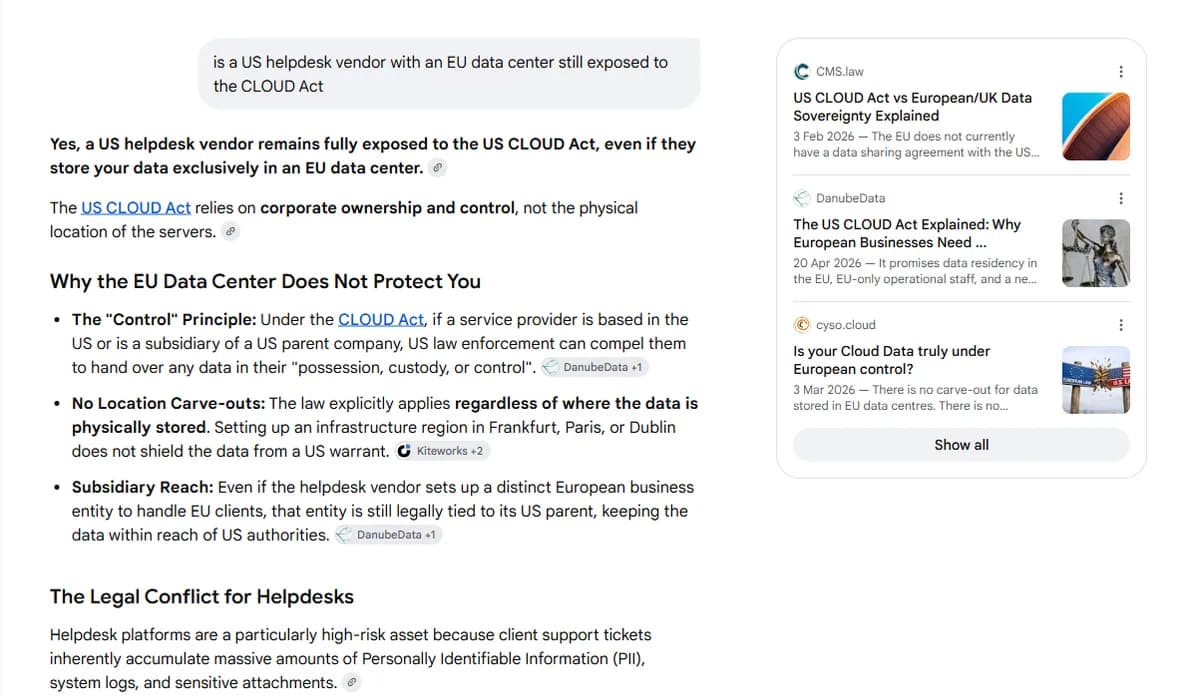
In our example the dominant objection is not price, it is jurisdiction. The question of whether a US vendor with an EU data center is still exposed to the CLOUD Act deserves a full page on its own, because it blocks the decision and it calls for a clear, sourced and dated answer. That is exactly the kind of sub-intent query fan-out will find elsewhere if your site does not cover it.
What Google actually publishes about query fan-out
Three official publications establish the facts about query fan-out. In March 2025, launching AI Mode, Google described a technique that issues multiple related searches concurrently across subtopics and multiple data sources, then brings those results together into one response. In May 2025 at Google I/O, Google added that AI Mode breaks a question into subtopics and issues a multitude of queries simultaneously on the user behalf, and that Deep Search pushes the same technique to hundreds of searches to produce a fully cited report. The Search Central documentation then gives the formal definition and lists it as one of the two mechanisms behind generative AI search, alongside retrieval-augmented generation, also known as grounding. Nothing in those three sources describes how many subqueries a given prompt produces, or which ones.
The Search Central documentation industrializes that message. The AI features page states that both AI Overviews and AI Mode may use the technique, and that it supports greater link diversity than a traditional search. The generative AI optimization guide adds the formal definition and the weeds example quoted above. Both pages also set the technical bar, your page must be indexed and eligible for search snippets, and the nosnippet, data-nosnippet, max-snippet and noindex directives remain the available controls.
Read the verb Google uses carefully. The documentation says these features may use query fan-out, not that they run it on every query. Presenting fan-out as a universal, deterministic mechanism would be an extrapolation. What Google does confirm is that the technique exists, what it is for, and that it widens the number of pages that can be cited inside one answer.
Google, AI Mode launch, March 2025 | Google, AI Mode and Deep Search, May 2025 | Google, AI features and your website
Is query fan-out specific to Google?
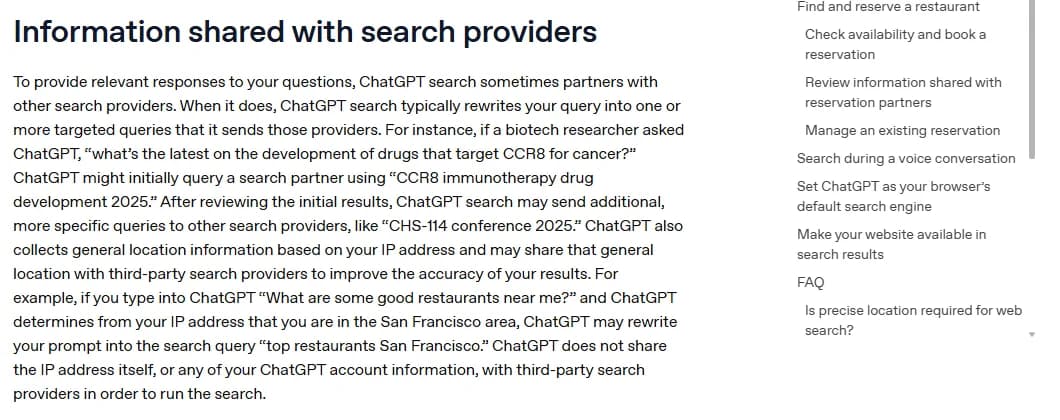
No. The name is specific to Google, the behaviour is shared by every answer engine that documents its search layer. OpenAI writes that ChatGPT search typically rewrites your query into one or more targeted queries sent to its search partners, and that it may send additional, more specific queries after reviewing the initial results. Its example is as telling as the Google lawn one, a question about drugs targeting CCR8 in oncology first becomes "CCR8 immunotherapy drug development 2025", then "CHS-114 conference 2025" once the first results are read.
Anthropic describes the same loop on the API side. The web search tool documentation states that Claude decides when to search, that the API runs the searches and returns the results, and that this process can repeat multiple times throughout a single request. It even gives an order of magnitude rarely published elsewhere, simple factual queries typically use 1 to 3 searches, while comparative or multi-entity research can use 10 or more. That is query fan-out, quantified by the provider itself.
Perplexity built it into its API. The Search API accepts up to five related queries in a single request, precisely to explore different angles of a topic, with each query processed independently. The vocabulary changes from one provider to the next, the editorial consequence does not, a buyer question is answered with a set of pages rather than a single page.
| Provider | Term used | What is documented | Subqueries visible |
|---|---|---|---|
| Google AI Mode and AI Overviews | Query fan-out | Concurrent related queries across subtopics, up to hundreds with Deep Search | No, neither in the answer nor in Search Console, no query dimension |
| Google Gemini | Grounding with Google Search | The model runs its own searches before answering | Yes, but only through the API, the google_search_call block returns the queries executed |
| OpenAI ChatGPT | Query rewriting, agentic search | One or more targeted queries, then more specific ones after reading results | Yes, the interface shows the searches, and web_search_call returns them on the API |
| Anthropic Claude | Web search tool | Loop repeatable within one request, 1 to 3 searches factual, 10 or more comparative | Yes, in the interface, and through the server_tool_use block on the API |
| Perplexity | Multi-query request | Up to five related queries per call to explore different angles | Yes, the searches it runs are displayed, and the Search API takes several queries |
OpenAI, searching the web with ChatGPT | OpenAI, web search tool | Anthropic, web search tool | Perplexity, Search API | Google, grounding with Google Search
Guides by engine. Get cited by Perplexity | Get cited by ChatGPT
Where can you read the subqueries actually executed?
Start with the one genuine blind spot, AI Mode and AI Overviews. Google does not expose the subqueries behind a question there, neither in the displayed answer nor in Search Console. The report dedicated to generative AI features, announced in June 2026, measures your impressions and breaks them down by page, country, date and device. It carries no query dimension, and it is rolling out to a subset of site owners. In other words, the closest official tool tells you that you were shown, never which subquery caused it. Anyone selling you the exact list of AI Mode internal queries is therefore selling an estimate rather than a measurement.
The rest of the landscape is far more open, and that is the good news in this guide. ChatGPT, Claude and Perplexity display the searches they run, right in their interface, while they answer. You only have to read them. On the API side, an Anthropic response contains a server_tool_use block holding the query the model wrote, the OpenAI web_search_call output usually includes the queries actually run, and the Gemini documentation states that the google_search_call block contains the search queries the model executed. For Gemini that API route is the only one, the consumer interface does not show them.
The dividing line is therefore not Google against the rest, it runs between surfaces. On AI Mode and AI Overviews you stay blind. On the other engines you can read the subqueries one by one. The real work is no longer obtaining them, it is collecting them regularly, against a stable prompt set, so a one-off rephrasing can be told apart from a durable pattern.
One distinction stays useful when comparing tools. Logging a query displayed by ChatGPT, Claude or Perplexity is a measurement, the query comes from the engine. Inferring what AI Mode might have searched is an estimate. Both have their place, they do not deserve the same wording, and mixing them in one table produces fragile conclusions.
We ran that test on our own example. Asking a narrow follow-up about CLOUD Act exposure at the same time, AI Mode produced a decisive answer built on an entirely different source set. Not one domain cited on the buying prompt reappeared on the subquery. On a verifiable case, that confirms a sub-intent is won with its own page, not with a paragraph buried inside a general article.
- Never present a third-party subquery list as the real set of queries Google fired.
- Date every observation, an AI Mode answer is not reproducible verbatim.
- Test English and French separately, our two captures return different brands and different sources for the same intent.
- Never conclude from a single test, repeat the measurement before making an editorial decision.
Google, generative AI performance reports in Search Console | Search Console, generative AI performance report | Anthropic, web search tool | OpenAI, web search tool
What our own logs show
Hikoo collects these queries and ties each one back to the prompt that triggered it, which makes it possible to look at a real fan-out rather than a presumed one. On our own domain, 2,268 unique queries were logged between April and August 2026. A single prompt already produces a lot of them, and the gap between engines is immediately visible.
Take the prompt "Is there a Google Search Console equivalent for generative AI?". It generated 126 distinct query variants. Gemini and Perplexity compress it into keywords, "Google Search Console equivalent IA generative", logged 20 times. Grok translates it, "Google Search Console equivalent for generative AI", logged 10 times. ChatGPT goes further and injects entities absent from the question, as in "AI search console equivalent generative AI analytics llms.txt OpenAI Bing Webmaster".
That last case is the most instructive for a content plan. The model decided on its own that answering this question meant covering llms.txt, Bing Webmaster Tools and OpenAI. A page mentioning none of those entities has little chance of being picked up on that branch of the fan-out, however good its answer to the original question. It is the concrete demonstration of the entities axis described earlier in the research plan.
- One prompt does not produce one query, it produces dozens, and they differ by engine.
- Rewriting often compresses the question into keywords rather than expanding it into sub-questions.
- Some engines translate the question, which moves the competition into another language corpus.
- The entities a model adds are the best topic list you can get, because they come from the engine rather than from you.
Related Hikoo guides. Which prompts mention your brand | Find the sources shaping LLM answers
A worked example, one hub and its satellite articles
A content plan built for query fan-out looks like a hub surrounded by satellites. The hub answers the full buying question, carries the comparison table and commits to a recommendation. Each satellite covers one sub-intent in depth, with a self-contained answer in its opening lines. The hub links to every satellite, each satellite links back, and satellites that share a criterion cite each other.
What should the hub contain?
The hub is the page that has to survive partial reading. A model that only reads its first third should already have the recommendation, the scope and the criteria. In practice that means a decisive answer up top, a complete comparison table, a methodology section explaining how you compared, and a visible update date.
- An explicit recommendation within the first sixty words, with the condition that makes it valid.
- A table whose columns are exactly the trade-off criteria found in the research plan.
- A dated methodology section, which makes the comparison verifiable rather than declarative.
- A link block pointing to the satellites, worded with the sub-intent rather than a generic label.
How should satellites be written?
A satellite is judged on its ability to answer alone. If an engine extracts its first hundred and fifty words without the rest of the page, the answer must stay accurate and complete. In our example four satellites cover most of the observed fan-out, the CLOUD Act question, what a workable data processing agreement must contain, self-hosting versus European cloud, and the real cost of migrating a helpdesk for a twenty-person team.
Each satellite adopts the vocabulary of its sub-intent rather than the vocabulary of the hub. That does not mean stuffing keyword variants into the page, since Google states its systems understand synonyms and the general meaning of a search. It means genuinely covering the angle, with the entities, objections and proof that belong to it.
Which page serves which sub-intent?
This table maps every sub-intent found in the AI Mode answer to the editorial format that serves it, the proof it requires, the target page and the internal link that ties it back to the cluster. Fill it once per buyer prompt and it becomes the production brief.
| Sub-intent | Format | Expected proof | Target page | Internal link |
|---|---|---|---|---|
| Which tool fits my context | Comparison with a recommendation | Criterion by criterion table and dated methodology | Hub | Out to all four satellites |
| Is a US vendor hosting in the EU compliant | Decisive sourced answer | Regulation cited with a verification date | Objection satellite | Back to hub, across to the DPA satellite |
| What belongs in an acceptable DPA | Contractual checklist | Clause list and a referenced public template | Compliance satellite | Across to the objection satellite |
| Self-hosting or European cloud | Decision analysis | Three-year total cost and operating load | Architecture satellite | Back to hub |
| What a migration really costs | Costed study | Explicit assumptions and an owned range | Budget satellite | Back to hub, out to pricing |
| Who uses this tool in my industry | Customer case or field report | Verifiable numbers and a stated scope | Evidence satellite | Back to hub |
Related concepts. Internal linking | Semantic search
How do you prioritize which subqueries to cover?
A fan-out grid always produces more topics than you can write. Useful prioritization cannot run on estimated volume, since nobody has volume data for internal subqueries. It runs on three signals you can actually observe, how often the sub-intent shows up in the answers you tested, how strong the currently cited sources are on that sub-intent, and how close the sub-intent sits to what you sell.
In practice, a blocking sub-intent that appears across several answers, is currently served by thin or ageing pages, and sits close to your offer, goes first. Conversely, a sub-intent already covered by solid institutional sources needs a genuinely new angle, otherwise it burns time without moving your position. Google says as much in its guide, commodity content adds little unique insight, and it is the distinctive viewpoint that pays off over time.
- Score recurrence, how many of your tests surface this sub-intent inside the answer.
- Score the weakness of incumbent sources, freshness, depth and authority of what is cited today.
- Score commercial proximity, does the sub-intent genuinely move the reader towards a decision.
- Handle blocking objections first, they are underserved and they unlock stalled buying cycles.
- Re-score the grid every quarter, answers shift and cited sources change.
Go further. Competitive analysis of AI citations | Elevate
How do you measure query fan-out work?
Measuring query fan-out work runs on three complementary planes, none of which is enough alone. The first is Search Console, with the generative AI performance report for how your impressions inside those features move, and the standard report for web search. The second is prompt tracking, replaying the same buyer questions on a fixed cadence and logging the brands and sources cited. The third is source analysis, knowing which content, yours and everyone else, actually feeds the answers in your category. None of these three planes returns the subqueries themselves, they return effects, which is enough to arbitrate an editorial plan but never enough to reconstruct the engine reasoning. Run all three or the picture stays partial, since each one is blind to what the other two see.
One methodological point avoids a lot of disappointment. Gains read at cluster level, not at page level. A satellite may never be cited directly while still making the hub citable, because it supplies the depth and the entities that were missing. Conversely, a rise in generative AI impressions says nothing about the subquery behind it, since that dimension does not exist in the report.
- Freeze a stable list of buyer prompts and replay it on a fixed cadence, otherwise your comparisons mean nothing.
- Track the share of answers where your brand appears, rather than a rank, which has no meaning inside a generated answer.
- Log the queries the engines display too, they hand you the entities to cover instead of leaving you to guess.
- Cross cited sources against your own pages to spot the sub-intents where you are absent.
- Log every satellite publication with its date, so a citation change can be tied back to an action.
Hikoo resources. Google Search Console for AI | AI Overviews impressions in Search Console | Appear in Google AI Overviews | Spotlight
The mistakes that waste the most time
Most mistakes come from a magical reading of fan-out. Google published a full myth-busting section in its optimization guide, and it contradicts several widespread practices head on. llms.txt files are not used by Google Search. Breaking content into tiny fragments is not a requirement. Structured data is not required for generative AI search and no special schema.org markup exists for it. Rewriting a text to match an exact phrasing is pointless, since the systems understand synonyms.
A second mistake is promising mechanical results. Semrush published an experiment where four articles were expanded to answer fan-out queries. Citations went from two to five in one month, but over the same period the measured share of voice fell from 23.4 percent to 20.0 percent and brand visibility from 13.6 percent to 10.6 percent. Even advocates of the method publish mixed results, which is a good reason to treat fan-out as a coverage discipline rather than a lever with guaranteed effect.
- Believing that covering subqueries guarantees a citation, no official source claims it.
- Publishing one thin page per subquery, which produces exactly the commodity content Google says it values least.
- Confusing subqueries inferred by a third-party tool with the real queries Google issued.
- Ignoring the update date, when freshness is often the only thing separating two equivalent pages.
Google, generative AI search mythbusting | Semrush, query fan-out experiment, September 2025
Frequently asked questions about query fan-out
Does query fan-out run on every Google query?
No, and Google does not claim it does. The documentation says AI Overviews and AI Mode may use the technique to build a response, without stating a frequency or a trigger threshold. Long, comparative or multi-constraint questions are the most likely candidates, but no public rule lets you know in advance whether a fan-out happened.
Can you see the subqueries generated for a given question?
Yes, except on AI Mode and AI Overviews. ChatGPT, Claude and Perplexity display the searches they run while answering, and their APIs return the generated queries. For Gemini you have to go through the API, whose google_search_call block holds the queries the model executed. Only Google search surfaces stay closed, the Search Console report for generative AI features breaking down by page, country, date and device, with no query dimension.
Do you need one page per subquery?
No, you need one page per genuinely distinct sub-intent. A sub-intent shows three signs, it calls for a different answer, it mobilises different entities, and it matters to a reader at a different point in the decision. If two phrasings call for the same demonstration and the same proof, they belong on the same page, and splitting them weakens the cluster.
Does query fan-out apply to ChatGPT and Perplexity too?
Yes. Only the term belongs to Google. OpenAI documents that ChatGPT rewrites a question into one or more targeted queries, then sends more specific ones after reading the first results. Anthropic documents a search loop repeatable within a single request, with 1 to 3 searches for a factual question and 10 or more for a comparison. The Perplexity Search API accepts up to five related queries per call. A Semrush study from June 2026 also measured, across one hundred prompts run twice, 245 web searches in minimal reasoning mode against 1,130 in high reasoning mode.
Does content optimized for Google fan-out help on other engines?
Largely yes, because the work targets sub-intent coverage rather than syntax specific to one engine. The four providers we cite describe the same thing, a model writing its own queries to cover several angles. One caveat holds, the sources actually selected differ sharply between engines and between languages, as our captures show. The structure transfers, the list of pages that win does not.
How long before you see an effect?
Google publishes no timeframe, and quoting a round number would be dishonest. What is observable is that generated answers change composition over time, including without any action from you. The only defensible approach is to freeze a prompt list, replay it on a regular cadence, and compare periods rather than moments.
Should you translate articles or write new ones per language?
Our two captures answer part of that. On the same buying intent, the French and English versions of AI Mode cite entirely different brands and sources. A literal translation is therefore not enough, you have to adapt entities, regulatory references and expected proof to the target market, even when the plan structure stays identical.
Does query fan-out change how SEO is measured?
It moves measurement from the page to the cluster. A satellite may never appear in an answer while still making the hub citable, because it supplies the missing depth. Tracking only individual URL performance therefore leads teams to delete content that actually carries the visibility of the whole set.
Where to start
Pick one buyer prompt, the one your sales team hears most often. Submit it to AI Mode, log the sub-intents and cited sources, fill the grid from this guide, then produce the hub and two satellites. Within a quarter you will know whether your category rewards depth or freshness, and you will hold a repeatable method rather than an intuition.
To follow the effect of that work without guessing, Hikoo replays your prompts, logs the search queries the engines actually run alongside the brands and sources cited, and shows where your cluster still misses a sub-intent. The 126 variants quoted above come from exactly that. Same material as the one used in this guide, measured continuously rather than once.
Sources
- Google Google's Guide to Optimizing for Generative AI Features on Google Search. Google Search Central, consulté en août 2026
- Google AI Features and Your Website. Google Search Central, consulté en août 2026
- Google AI Mode in Google Search, Updates from Google I/O 2025. The Keyword, 20 mai 2025
- Google Expanding AI Overviews and introducing AI Mode. The Keyword, 5 mars 2025
- Google Introducing Search Generative AI performance reports in Search Console. Google Search Central Blog, juin 2026
- Google Generative AI performance report (Search). Search Console Help, consulté en août 2026
- OpenAI Searching the web with ChatGPT. OpenAI Help Center, consulté en août 2026
- OpenAI Web search. OpenAI API documentation, consulté en août 2026
- Anthropic Web search tool. Claude platform documentation, consulté en août 2026
- Google Grounding with Google Search, Gemini API. Google AI for Developers, consulté en août 2026
- Perplexity Search API quickstart. Perplexity documentation, consulté en août 2026
- Semrush Only 25% of cited sources overlap between ChatGPT different reasoning modes. Semrush Blog, 30 juin 2026
- Semrush We Tested Query Fan-Out Optimization, Here is What We Learned. Semrush Blog, 26 septembre 2025