In short
A GEO tool for ecommerce tracks your products, not just your brand, in AI answers and in their shopping cards. Hikoo asks up to 9 engines your customers' buying questions every day and prepares the fixes for product pages and content. Azoma and Goodie go down to SKU level and cover shopping agents such as Alexa for Shopping. Rankscale analyzes the shopping answers of ChatGPT, AI Mode and Copilot, and Evertune the product cards of ChatGPT. Botify, Productsup and Akeneo add an AI module to tools large merchants already run, and Yotpo Discover targets brands above $10 million in annual GMV. None of these tools replaces the basic building blocks, Merchant Center, ChatGPT product feeds, Product structured data and GA4, which feed what AI assistants recommend and measure the sales that follow.
Short answer
What are the best GEO tools for an ecommerce site?
A GEO tool for ecommerce measures whether your products are recommended by ChatGPT, Gemini, Perplexity, Copilot or retailer shopping assistants, on the questions your customers ask before buying. The best ones go beyond brand tracking. They spot which exact product is cited, in which shopping card, at what price and from which merchant, then help fix the product page or feed that costs you the recommendation. Hikoo covers up to 9 engines and prepares those fixes. Azoma and Goodie track SKUs all the way into Alexa for Shopping. Rankscale and Evertune analyze product cards in shopping answers. Botify, Productsup AI Visibility, Yotpo Discover and Akeneo PX Insights add this measurement to platforms large merchants already use. The right choice depends on your sales channels, your size and the AI assistants your customers use.
The table below sums up our shortlist. Features and prices were taken from each vendor site on October 28, 2026. We do not link to competing tools, the pages we checked are listed in the sources at the end of the article.
| Tool | What it tracks | AI covered | Public price |
|---|---|---|---|
| Hikoo | Buying questions, citations, share of voice, sources, fixes for product pages and content | ChatGPT, Gemini, Perplexity, Copilot, Claude, Mistral, Grok, AI Overviews, AI Mode | Free, then EUR 69, 179 and 499 per site per month, excl. VAT |
| Azoma | Brand, category and SKU visibility, retailer shopping agents | Alexa for Shopping, Walmart Sparky, ChatGPT, Gemini | On quote, plans for brands and agencies |
| Goodie | SKU level products, merchants, competing products, feed fixes | ChatGPT Shopping, AI Mode Shopping, Alexa for Shopping | $295 per month, SKU tracking in the $999 plan |
| Rankscale | Products, offers, merchants and ads in shopping answers | ChatGPT, Google AI Mode and Copilot shopping | EUR 99 per month with shopping analysis |
| Evertune | Product cards, prices, reviews and recommended retailers | ChatGPT shopping | $60 per month on Starter, $800 per month on Pro |
| Botify | AI visibility and products in AI shopping results | ChatGPT, AI Mode, AI Overviews, Gemini, Perplexity | Option on Botify plans |
| Productsup AI Visibility | Brand and category visibility, against up to 10 competitors | ChatGPT, Gemini, Perplexity, AI Mode | EUR 24,000 for 12 months in EMEA, bundled offer |
| Yotpo Discover | Products, categories and regions, agents acting on the catalog | ChatGPT, Gemini and other engines | Custom, brands above $10M GMV |
| Akeneo PX Insights | Simulated AI rank of each product | ChatGPT, Gemini, Claude | Optional module of Akeneo Product Cloud |
Criteria
What should a GEO tool for ecommerce measure?
A classic brand tracking tool counts mentions of your name. For a store, that is not enough, because AI recommends specific products, often in a card with a price, a rating and a link to a merchant. These are the criteria we used to select the tools in this shortlist.
- Product level and not only brand level, to know which SKU is recommended and on which question.
- Product cards in the shopping answers of ChatGPT, AI Mode or Copilot, with the price, reviews and merchant shown.
- The retailers and marketplaces cited instead of you, as well as retailer shopping agents such as Alexa for Shopping or Walmart Sparky if you sell there.
- The sources behind the recommendation, such as comparisons, reviews and merchant pages.
- A path to action on product pages, feeds or content, otherwise measurement stays a simple observation.
- Coverage of your markets, since some tools only analyze in English or only track part of the AI assistants.
Learn more. AI share of voice | Find the sources behind AI answers
How it works
How do ChatGPT, Gemini and Copilot pick the products they recommend?
AI assistants draw on two sources to recommend a product, the web they crawl and the catalogs merchants send them. Google builds its shopping experiences on the Shopping Graph, which Google says holds more than 60 billion continually refreshed product listings, and Merchant Center free listings can appear at no cost in Google Search as well as in Gemini. Microsoft explains that Copilot organic results rely on information found on the web and on the merchant feed in Microsoft Merchant Center. OpenAI, for its part, extended the Agentic Commerce Protocol to product discovery in March 2026, so that merchants share their feeds and their catalogs are accurately represented in ChatGPT. A GEO tool for ecommerce shows which of these two sources is costing you a recommendation.
Google also states that there is no special optimization needed to appear in AI Overviews or AI Mode. Its guidance remains standard SEO, with one concrete point for merchants, checking that Merchant Center and Business Profile information is up to date.
Google, Universal Cart and Shopping Graph | Merchant Center, free listings | Microsoft, agentic commerce | OpenAI, product discovery | Google, AI features
GEO platform
1. Hikoo, track and win AI recommendations across 9 engines
Hikoo is the GEO platform we build. Every day it asks AI assistants the questions your customers ask before buying, such as "which robot vacuum for a flat with a dog" or "best trail running shoes for beginners", then measures whether your brand is cited, in which position, with which tone and against which competitors. The Agent plan covers 9 engines, ChatGPT, Gemini, Perplexity, Microsoft Copilot, Claude, Mistral, Grok, Google AI Overviews and Google AI Mode.
Measurement is only the first step. Source analysis shows which pages AI assistants cite when they recommend a competitor, often a comparison, a product review or a marketplace. The site agent reads every page the way an AI engine reads it, judging a product page differently from a blog post, and prepares the fix ready to publish, a rewritten heading, an added FAQ or completed structured data. The content agent writes the missing buying guides, and the outreach agent contacts the sites that matter to earn a mention. Reporting then ties every gain to the action that produced it.
The Free plan tracks 10 questions on ChatGPT. Monitoring, at EUR 69 per site per month excluding VAT, tracks 30 questions on ChatGPT and Gemini. Growth, at EUR 179, moves to 80 questions on 4 engines and adds source analysis. Agent, at EUR 499, tracks 200 questions on 9 engines and also does the work on your site, content and citations. It is the plan we recommend to a brand whose catalog runs past a few dozen products, because the number of buying questions to cover grows with each product line.
- Daily tracking of 200 buying questions across 9 AI engines on the Agent plan
- Comparison with up to 20 competitors and analysis of cited sources
- Product page fixes and content prepared, published on their own or after your review
- MCP server to query your Hikoo data from your AI client
Go further. AI visibility for ecommerce | Site agent | Reporting agent | Pricing
Ecommerce specialist
2. Azoma, SKUs tracked all the way into retailer shopping agents
Azoma, founded in 2022 and headquartered in London with an office in Toronto, describes itself as an agentic commerce optimization platform. It tracks brand, category and SKU visibility across language models and retailer shopping agents, such as Alexa for Shopping at Amazon, Walmart Sparky, ChatGPT or Gemini. The tool connects to Amazon, Walmart, PIM systems, Shopify and Google Merchant Center to pull in and optimize product data continuously. Pricing is on quote, with separate plans for brands and for agencies. On October 21, 2026, the company announced an $11.2 million Series A led by Puma Growth Partners.
Ecommerce specialist
3. Goodie, product by product tracking in ChatGPT Shopping and AI Mode
Goodie tracks how your products appear in ChatGPT Shopping, Alexa for Shopping and AI Mode Shopping, at SKU level. Its agentic commerce suite shows which products get mentioned, where they rank in product comparisons, which merchants sell them and which competing products appear alongside. It also lets you fix the feed, generate product copy and FAQs, inject structured data and optimize images. The Core plan costs $295 per month with a 7 day free trial, and SKU level agentic commerce visibility is part of the Pro plan at $999 per month.
AI shopping
4. Rankscale, the shopping answers of ChatGPT, AI Mode and Copilot
Rankscale, an Austrian company based in Vienna, offers a shopping analysis that shows which brands, products and merchants appear in the shopping answers of ChatGPT, Google AI Mode and Copilot. The tool tracks manufacturers and retailers in one place, shows when a competing seller takes the top spot and spots the sponsored ads shown in those answers. Shopping analysis is included from the Pro plan at EUR 99 per month, which can be tried for free, with entry plans starting at EUR 20.
AI shopping
5. Evertune, ChatGPT product cards under the microscope
On January 14, 2026, Evertune launched Shopping Intelligence, a feature dedicated to ChatGPT shopping recommendations. When ChatGPT displays product cards with prices, reviews and purchase links, the tool captures every recommended product with a visibility score, pricing data and ratings, as well as the retailers that appear most often in your category, including for brands you do not track. The shopping layer focuses on ChatGPT. The Starter plan costs $60 per month and the Pro plan $800 per month, billed annually.
Ecommerce suite
6. Botify, AI visibility from a Paris based SEO suite
Botify, founded in 2012 and published by a company registered in Paris, is a search platform built for sites at massive scale, with offices from New York to Tokyo. Its AI Visibility module, available as an option on all its plans, measures visibility and share of voice across ChatGPT, Perplexity, Google AI Mode, AI Overviews and Gemini. Since May 2026, Product Cards show when your products appear in AI shopping results, benchmark them against competitors and spot missing products, with a path to action through AgenticCatalog. It is a natural pick if your team already uses Botify for SEO.
Feeds and measurement
7. Productsup AI Visibility, measurement wired to the product feed
Productsup, an enterprise feed management platform, launched AI Visibility on July 8, 2026. The dashboard measures the visibility of your brands and product categories in ChatGPT, Gemini, Perplexity and Google AI Mode, on predefined shopping intents, against up to 10 competitors you select, with a focus on organic results. Its strength is the loop with the feed, since categories with low visibility can be enriched right away with AI Enrich. Productsup sells the set in a limited time bundle, EUR 24,000 for 12 months in EMEA against a list price of EUR 33,000.
Reviews and loyalty
8. Yotpo Discover, AI visibility tied to reviews and loyalty
Yotpo, known for its customer reviews and loyalty solutions, offers Discover, a language model visibility tool wired to the catalog. It tracks where your products land in ChatGPT, Gemini and other engines, split by product, category and region, and relies on agents that work your reviews, loyalty program and commerce data. It integrates with Shopify, Salesforce Commerce and Adobe Commerce. The first release targets brands above $10 million in annual GMV, and plans are built to measure.
PIM
9. Akeneo PX Insights, the AI rank of every product page
Akeneo, a PIM vendor founded in 2013 and based in Nantes, offers PX Insights, an optional module of Akeneo Product Cloud. Its AI Discovery Optimization feature simulates shopping searches on ChatGPT, Gemini and Claude, then gives each product an AI Search Rank, its position in the simulated answer, to help optimize the product page. It is a simulation rather than tracking of real answers, limited to 20 products per analysis and currently run in English only. It suits a product team that wants to fix its product data directly in the PIM.
Complements
Which building blocks should you plug in alongside a GEO tool?
A GEO tool measures, but your feeds and product pages are what AI assistants feed on. Merchant Center sends your catalog to Google for free, and its free listings can appear on Google Search, Google Maps, Gemini and YouTube. Google says that providing both structured data and a Merchant Center feed maximizes the eligibility of your products. An AI performance insights report measures conversational queries with shopping intent in AI Mode and AI Overviews, for now in English in five countries, and conversational attributes have been available to retailers worldwide since May 2026.
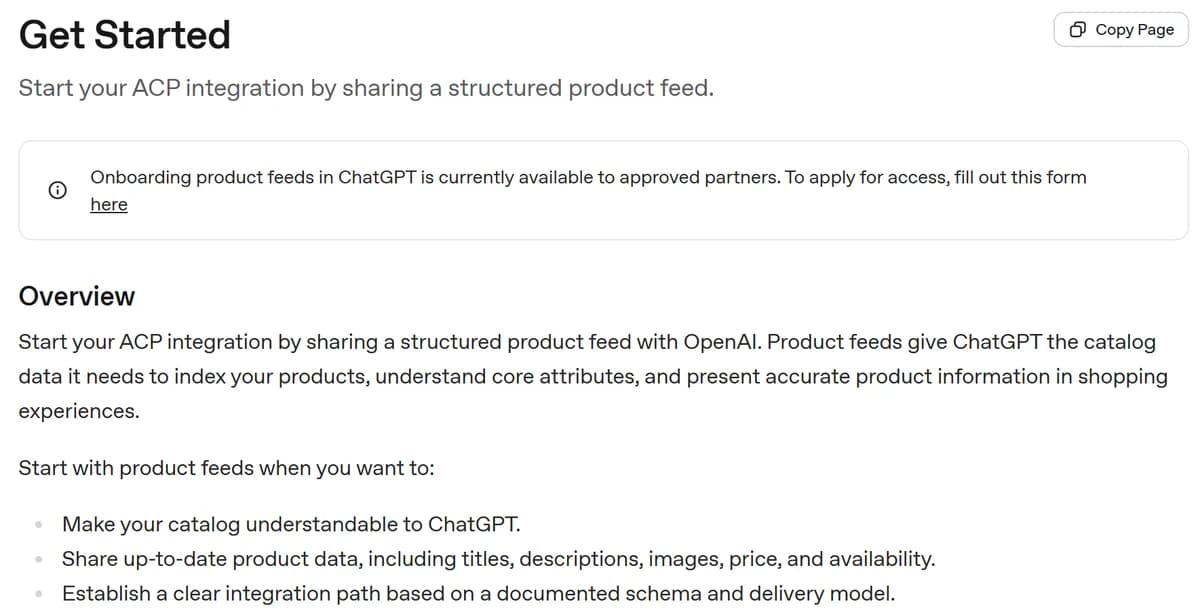
On the ChatGPT side, OpenAI extended the Agentic Commerce Protocol to product discovery in March 2026, and onboarding product feeds is currently open to approved partners, by application. Each feed row carries, among other fields, an ID, a title, a description, a URL, a brand, an image, an availability value and a price. Shopify stores reach ChatGPT through Shopify Catalog with no action on their part.
One setting often goes unnoticed. OpenAI states that sites opted out of OAI-SearchBot are not shown in ChatGPT search answers, though they can still appear as navigational links. Check your robots.txt before anything else.
To tie recommendations to sales, GA4 has grouped visits from AI assistants into an AI Assistant channel since May 13, 2026, covering sources like ChatGPT, Gemini, Deepseek, Copilot or Grok. AI Overviews and AI Mode are not part of it and stay counted in Organic Search.
Merchant Center, free listings | Product structured data | AI performance insights | Conversational attributes | Google Marketing Live 2026 | OpenAI, get started with feeds | Product feed specification | OpenAI, crawlers | GA4, what's new | GA4, default channel group
Related reading. Robots.txt and AI crawlers | Measure AI traffic in GA4 | AI crawler access checker
Checks
How do you check the Product data on your pages?
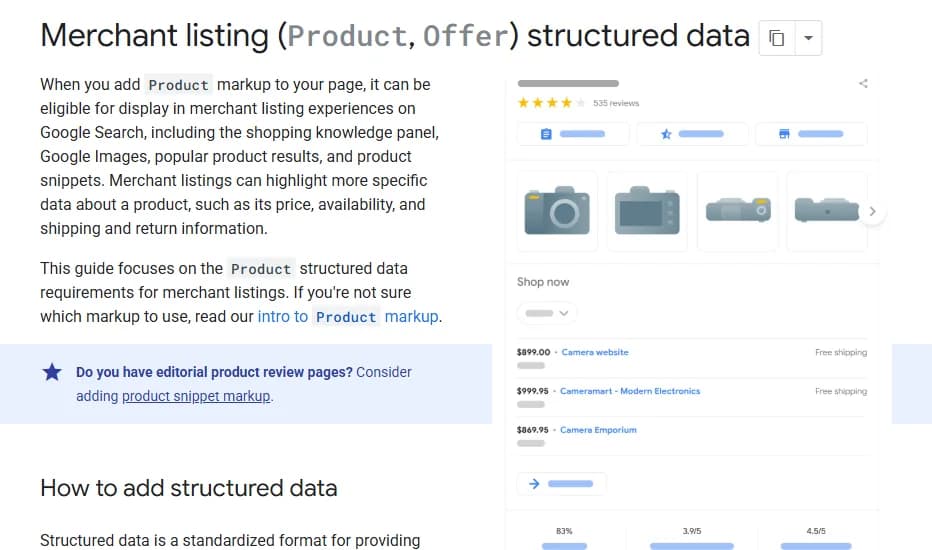
Product structured data describes a product page in a format that Google and other engines read without ambiguity. For a merchant listing, name, image and offers are required, with price and priceCurrency in the offer, and Google recommends adding shippingDetails, hasMerchantReturnPolicy, gtin and brand. The free Google Rich Results Test checks a page in seconds.
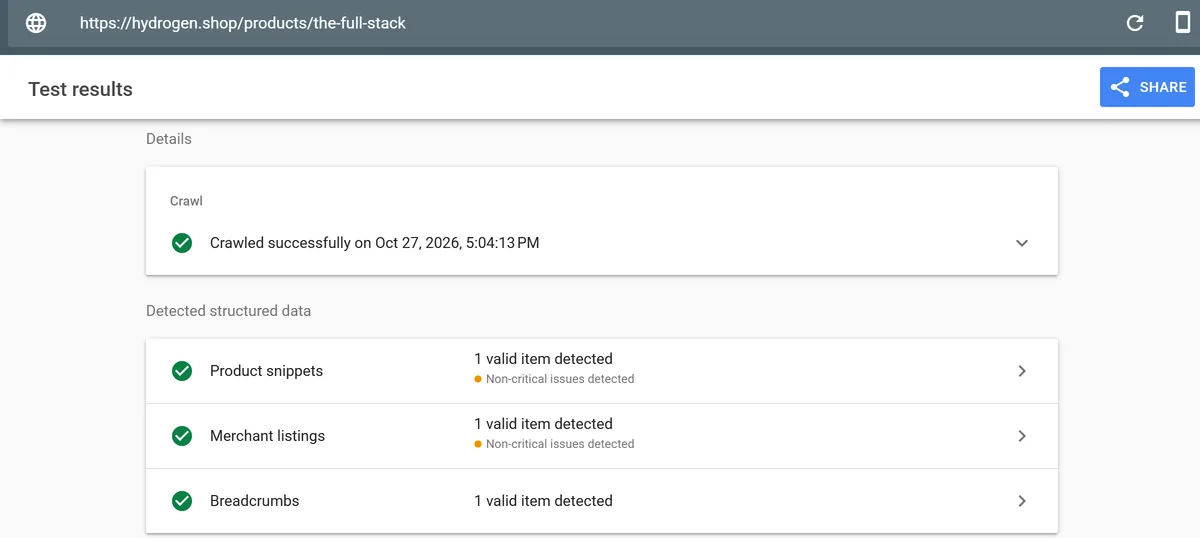
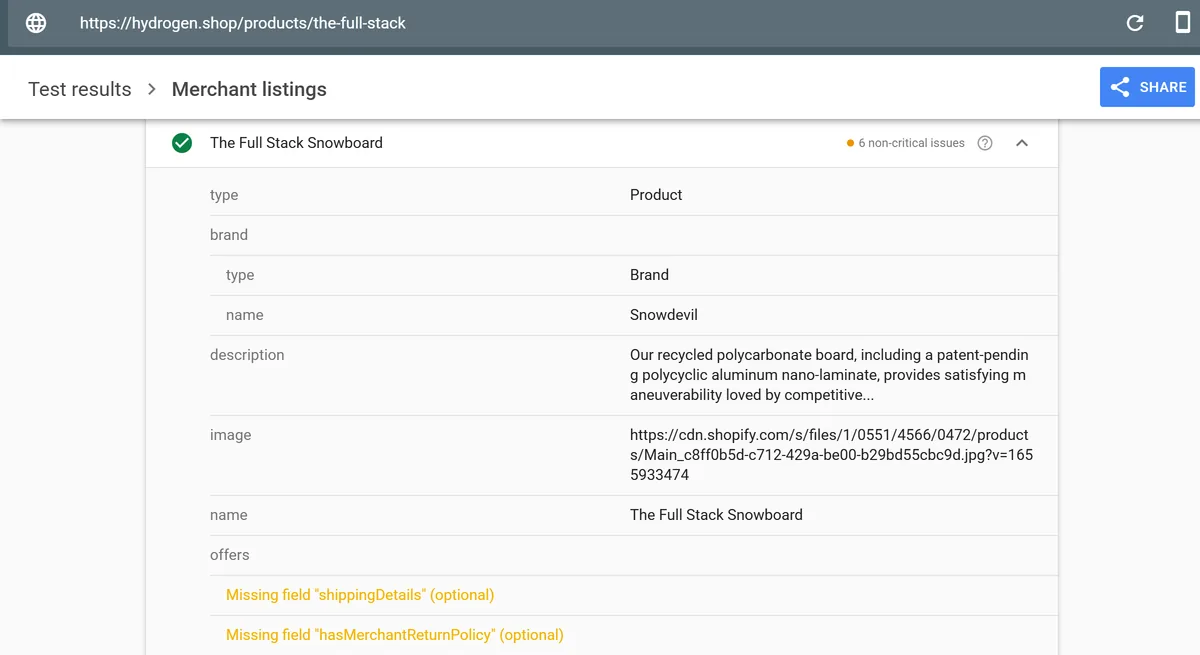
On October 27, 2026 we ran a product page from the Shopify Hydrogen demo store, hydrogen.shop, through the Google Rich Results Test. The tool detects three valid items, a product snippet, a merchant listing and a breadcrumb, which makes the page eligible for rich results. The merchant listing detail still reports six warnings rated as non critical, the same pair of missing fields on each of the three offers, shippingDetails for delivery and hasMerchantReturnPolicy for returns. The page is valid, yet it passes on neither shipping costs nor return terms, two pieces of information that shoppers compare and that Google lists among the recommended properties. A recent ecommerce theme does not guarantee complete markup, which is why every product page template you use deserves its own test.
Once the markup is in place, Search Console tracks its status across the site. Its Shopping reports cover merchant listings, product snippets, a shipping and returns setting linked to Merchant Center and merchant opportunities.
Merchant listings | Product structured data | Search Console Shopping reports | Rich Results Test
Related reading. Google Search Console for AI | Appearing in AI Overviews | Schema markup
Choosing
Which GEO tool fits your store?
The right tool depends first on where your customers buy. A brand that sells mostly on its own site needs to track ChatGPT, Gemini, Perplexity and AI Mode on its buying questions, then fix its product pages and content, which is what Hikoo does. A consumer goods brand sold through Amazon or Walmart also needs to watch the shopping agents of those retailers, the home ground of Azoma for Amazon and Walmart, and of Goodie for Amazon. Teams that mainly want to read the product cards of shopping answers will look at Rankscale or Evertune. Finally, a company already running Botify, Productsup, Yotpo or Akeneo can switch on the AI module of its current tool for a first reading, without mistaking it for complete tracking of its buying questions across several engines. In every case, measure before you invest, because no tool guarantees a recommendation.
| Your situation | Recommended tools |
|---|---|
| Brand selling mostly on its own site, in France or elsewhere in Europe | Hikoo to track 9 engines and fix product pages and content |
| Consumer goods brand sold through Amazon, Walmart or large retailers | Azoma or Goodie for retailer shopping agents, Hikoo for general AI assistants |
| Team that wants to track product cards in ChatGPT, AI Mode and Copilot | Rankscale or Evertune, with Hikoo for citations and sources |
| Enterprise already using Botify, Productsup, Yotpo or Akeneo | The AI module of the current tool for a first reading, Hikoo to track 9 engines and act |
To benchmark your store. Free AI audit | Prepare your site for AI agents | Measure GEO ROI
Avoid
Which mistakes keep your products out of AI answers?
These mistakes come up in platform documentation and in product page tests. A GEO tool helps you spot them, but each one is fixed on your site or in your feed.
- Blocking OAI-SearchBot in robots.txt, which removes the site from ChatGPT search answers.
- Tracking only brand queries, without the buying questions where your products should appear.
- Watching only ChatGPT, when your customers also use AI Mode, Gemini, Copilot or a retailer assistant.
- Letting the feed and the page show different prices, while Merchant Center compares the two and flags the gap as an error.
- Leaving shipping and returns out of the markup, as on the Hydrogen page tested above.
- Reading the GA4 AI Assistant channel as a total, when AI Overviews and AI Mode stay in Organic Search.
- Promising your team a citation. No tool or tactic guarantees one, only regular measurement shows what is improving.
Frequently asked questions
What is a GEO tool for ecommerce?
It is software that asks AI assistants your customers' buying questions and records which products, brands and merchants they recommend. The most complete ones track products one by one, analyze the shopping cards of ChatGPT or AI Mode and suggest fixes for product pages, feeds or content.
How does it differ from a general GEO tool?
A general tool mostly tracks brand mentions in written answers. A tool built for ecommerce goes down to product level, spots the retailers and marketplaces that get cited, and reads shopping cards with their prices and reviews. For a store, that level of detail is what explains a lost sale.
Which tools track ChatGPT product cards?
According to their official pages checked on October 28, 2026, Evertune, Goodie and Rankscale track the products shown in ChatGPT shopping answers. Rankscale also covers AI Mode and Copilot, Goodie covers AI Mode and Alexa for Shopping, and since May 2026 Botify shows when your products appear in AI shopping results.
Can you track Amazon's shopping assistant?
Yes, with some tools. Azoma and Goodie say they track Alexa for Shopping, the name Amazon now gives to the shopping assistant it launched as Rufus, and Azoma adds Walmart Sparky. General assistants such as ChatGPT, Gemini or Perplexity still need tracking on the side, since they do not rely on the same data.
Does a Shopify store need to do anything to appear in ChatGPT?
For discovery, OpenAI says Shopify products already reach ChatGPT through Shopify Catalog, with no action required from the merchant. What remains is checking product page quality, markup and robots.txt, then measuring with a GEO tool what ChatGPT actually recommends on your buying questions.
How do you measure sales generated by AI assistants?
Start from the GA4 AI Assistant channel, which since May 2026 groups visits from ChatGPT, Gemini, Copilot, Grok or Deepseek, and cross it with purchases. Track AI Overviews and AI Mode separately, since they stay in Organic Search. Then compare those numbers with the trend in recommendations measured by your GEO tool.
What budget should you plan for an ecommerce GEO tool?
Among plans listed per month and checked on October 28, 2026, prices range from $60 for Evertune Starter to $999 for the Goodie Pro plan, with Rankscale at EUR 99 including shopping analysis. Azoma, Yotpo Discover and Akeneo PX Insights are on quote, and Productsup sells its bundle at EUR 24,000 for 12 months in EMEA. At Hikoo, the Agent plan at EUR 499 per site per month excluding VAT includes tracking on 9 engines and the work on product pages, content and citations.
Conclusion
The best GEO tools for ecommerce no longer just count brand mentions. They track products, shopping cards and merchants, and help fix what costs you a recommendation. The choice depends on your sales channels, your size and the AI assistants your customers use.
The next step is to measure where you start from. Run the free AI audit on your store, then track in Hikoo the buying questions that matter for your catalog, to see which products get cited and which ones slip away.
Sources
- 1Google Universal Cart and the Shopping Graph. The Keyword, October 15, 2026
- 2Google About free listings. Merchant Center Help, consulted October 27, 2026
- 3Google AI performance insights. Merchant Center Help, consulted October 27, 2026
- 4Google Conversational attributes. Merchant Center Help, consulted October 27, 2026
- 5Google Shopping updates from Google Marketing Live. The Keyword, May 20, 2026
- 6Google AI features and your website. Google Search Central, last updated December 10, 2025
- 7Google Introduction to Product structured data. Google Search Central, last updated December 10, 2025
- 8Google Merchant listing (Product, Offer) structured data. Google Search Central, last updated September 8, 2026
- 9Google Shopping reports and settings in Search Console. Search Console Help, consulted October 27, 2026
- 10Google Rich Results Test. Test run on October 27, 2026
- 11OpenAI Powering product discovery in ChatGPT. OpenAI, March 24, 2026
- 12OpenAI Commerce, Get Started. OpenAI developer documentation, consulted October 27, 2026
- 13OpenAI Product feed specification, file upload. OpenAI developer documentation, consulted October 27, 2026
- 14OpenAI Overview of OpenAI crawlers. OpenAI developer documentation, consulted October 27, 2026
- 15Microsoft Advertising Agentic commerce. Microsoft Advertising, consulted October 27, 2026
- 16Google What's new in Google Analytics. Analytics Help, AI Assistant channel entry of May 13, 2026
- 17Google Default channel group. Analytics Help, consulted October 27, 2026
- 18Azoma Home page, AI instructions page and Series A announcement. Official page checked on October 28, 2026, not linked
- 19Goodie Agentic commerce suite and pricing pages. Official page checked on October 28, 2026, not linked
- 20Rankscale Shopping analysis, pricing and company facts pages. Official page checked on October 28, 2026, not linked
- 21Evertune Shopping Intelligence page, launch release and pricing page. Official page checked on October 28, 2026, not linked
- 22Botify AI Visibility page, AI Visibility FAQ, May 2026 release notes and About page. Official page checked on October 28, 2026, not linked
- 23Productsup AI Visibility page, help center dashboard page, launch news and AI discovery offer. Official page checked on October 28, 2026, not linked
- 24Yotpo Discover product page and Discover pricing page. Official page checked on October 28, 2026, not linked
- 25Akeneo PX Insights page and AI Discovery Optimization help page. Official page checked on October 28, 2026, not linked