In short
Tracking your products in ChatGPT means asking your customers' buying questions on a regular schedule and recording what the answer shows, the product, its rank, its price, the merchant and the cited sources. OpenAI says these results aren't ads and draw on product metadata from third party providers and on web content. Answers move a lot. In October 2026 Ahrefs measured that around 60% of ChatGPT citations disappear from one day to the next, and that three quarters of the ones that drop out come back within 20 days. A single check proves nothing. Read your results over a rolling week, language by language, and compare them with Gemini and Copilot, where more than half of answers cite no source at all. ChatGPT's outbound links carry the utm_source=chatgpt.com parameter, which lets you tie a recommendation to a sale in GA4.
Stakes
Why track your products in ChatGPT, not just your brand?
When a question signals buying intent, ChatGPT shows products with an image, a price, a few selling points and links to the sites that sell them. OpenAI states that ChatGPT selects these results independently, that they aren't ads and that no partnership influences them. A shopper who clicks arrives with a shortlist already made. In our October 30, 2026 test, that shortlist held four robot vacuums. Tracking your brand isn't enough to know whether your product made the cut. A brand can be named in the text while its flagship product is missing from the list, or listed with a reseller's price and link. For a store, the right unit of measurement is the product, crossed with the buying question and the merchant shown, because that is where the sale is decided.
ChatGPT also has ads. OpenAI has been testing them since February 9, 2026, first in the United States and then in other regions, on the Free and Go plans. The ad appears below the answer and is clearly labeled. According to OpenAI, ads run on separate systems and advertisers can't shape or rank answers. In your records, always separate the organic recommendation from the paid unit.
OpenAI, shopping with ChatGPT search | OpenAI, ads in ChatGPT
Go further. AI visibility for ecommerce | Best GEO tools for ecommerce
Mechanics
How does ChatGPT pick the products it shows?
According to OpenAI's help center, updated on October 28, 2026, ChatGPT shows a product when it judges it relevant to the intent of the question, taking the user's context into account, such as memory or custom instructions. To choose, it combines structured metadata from first party and third party providers, such as price and description, other third party content, the responses the model generated before it looked at new search results, and OpenAI's safety standards. When several merchants sell the same product, they are ranked on availability, price, quality and whether they are the maker or primary seller. OpenAI also warns that not every available product will be shown. A good product can easily be left out, and only a question by question check will show it.
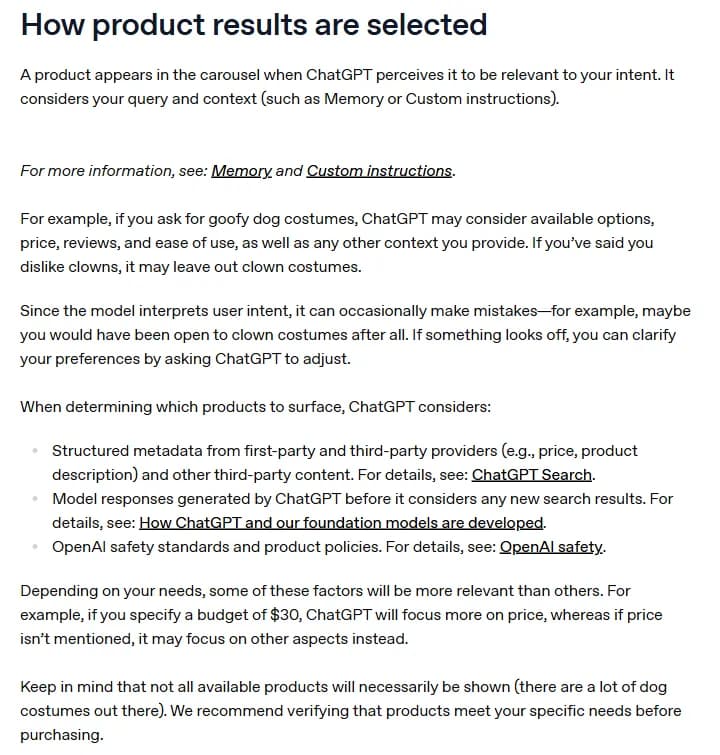
Several details on that page matter to a merchant. Shopify stores are integrated through Shopify Catalog with no action on their part, and other merchants can apply for direct feed access. The price shown in the first answer is usually the first listed merchant's price, which isn't always the lowest, and a price or shipping change can take a while to show up. Labels such as "Budget-friendly" and review summaries are generated by the model from public content, and OpenAI doesn't verify them.
On the search side, when ChatGPT goes through a partner search provider, it typically rewrites the question into one or more targeted queries, and it uses an approximate location derived from the IP address. A site that blocks OAI-SearchBot doesn't appear in ChatGPT search answers, and OpenAI says a robots.txt change takes about 24 hours to apply.
OpenAI, how product results are selected | OpenAI, web search | OpenAI, crawlers
Read next. Robots.txt and AI crawlers | AI crawler access checker | Get cited by ChatGPT
Method
Which prompts should you track for each product?
A useful prompt is a question a buyer really asks before choosing, without your brand name in it. Start with the product lines that weigh most in your revenue or margin, then write at least one question per intent family for each of them. The table lists the six families we use, shown on robot vacuums.
Then keep two groups apart in your results. Questions that name your product measure what the AI knows about it, and questions that don't name it measure your share of recommendations. Ahrefs advises the same split, because a strong score on brand questions can hide an absence on discovery questions. Also adapt each question to the language and country of every market. In our test, the same question asked in French and then in English, from France and a few minutes apart, produced two different lists.
| Question family | Example | What you measure |
|---|---|---|
| Category and use | "Which robot vacuum for an apartment with a dog?" | Whether your product makes its category shortlist |
| Budget | "Best robot vacuum under 400 euros?" | Whether your price keeps you in the selection |
| Comparison | "Roborock or Dreame for dog hair?" | How the AI compares you with your direct competitor |
| Alternative | "A cheaper alternative to the Roborock Qrevo 5AE?" | Whether you win a competitor's customers |
| Problem to solve | "My vacuum keeps tangling with dog hair, which one should I get?" | Whether your product claims answer the real need |
| Named product | "Is the Dreame D20 Pro Plus worth it?" | What the AI says about your product, its price and its flaws |
Learn more. Which prompts your brand appears on | Prompt intent | Compare AI visibility with competitors
Checklist
What should you record in each ChatGPT answer?
For each question, record what the buyer sees, in the text and in the product panel that opens on click. On October 30, 2026, from France and without an account, we asked ChatGPT "Which robot vacuum should I buy for an apartment with a dog, budget 400 euros?". It answered with four products, each with a price, four selling points and, for three of them, a review site cited as the source.
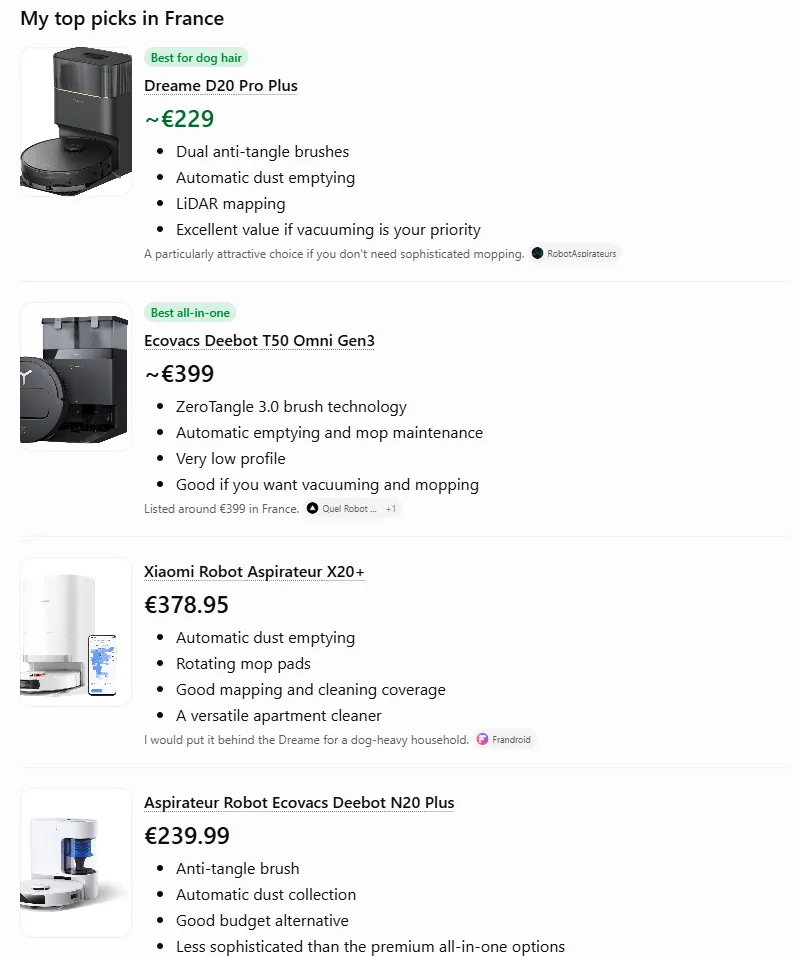
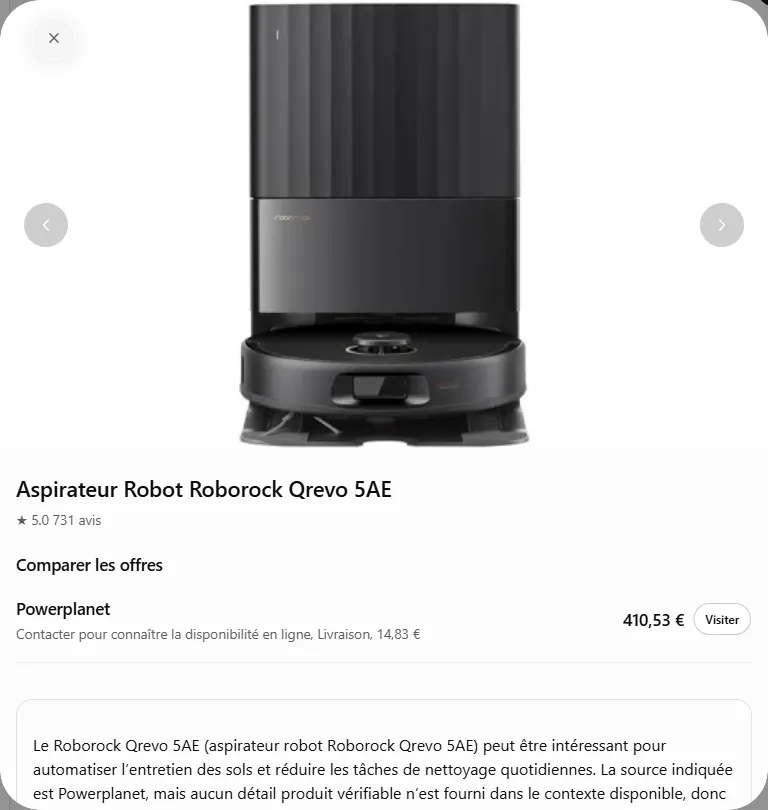
The product panel does not tell the same story as the answer. In the French version of the test, the Roborock Qrevo 5AE was listed as the first choice at €399.99, with the price spotted at Fnac. Once opened, its panel showed a single offer, Powerplanet at €410.53 plus €14.83 shipping, and the generated summary below it even admitted that the source provided no verifiable product details. In English, a few minutes later, the Roborock was gone and the Dreame D20 Pro Plus took first place at about €229, against €189 in the French answer. For a brand, that makes three things to track, the rank it gets, the price actually offered and the merchant who wins the click. A maker can be recommended first while the sale goes to a reseller it never chose, at a higher price than quoted.
| Field | What to record | Why |
|---|---|---|
| Presence | Product cited or missing, exact name used | Basis of your share of voice per product |
| Rank | Position in the list, labels such as "Best for dog hair" | The first product cited gets the most attention |
| Price | Price in the answer and price in the product panel | Flags a misaligned feed or reseller |
| Merchant | Merchant cited and the offers listed in the panel | Shows who wins the click and the sale |
| Reviews | Rating and number of reviews shown | Summaries generated from public reviews |
| Sources | Sites cited below the answer or in the panel | Tells you where to act to win the spot |
| Competitors | Products cited instead of yours | Gives each fix its target |
| Ads | Unit labeled as an ad below the answer | Separates organic from paid |
Learn more. AI share of voice
Sources
How do you read the citations and sources in an answer?
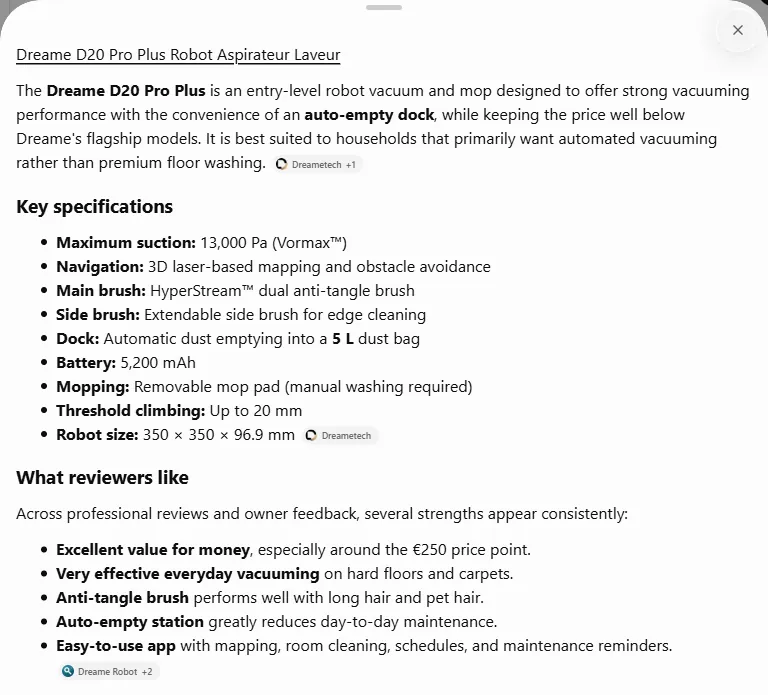
An answer that uses web search can show citations, and the Sources button lists the cited pages along with other relevant links. OpenAI notes that these citations can be incomplete, outdated or wrong. Open every source before drawing any conclusion. In our French test, the selection relied on two comparison sites, Frandroid and Meilleur Aspirateur Poils de Chien. In English, it relied on RobotAspirateurs, Quel Robot Aspirateur and Frandroid. The panel for the Dreame D20 Pro Plus attributed its technical specifications to Dreametech, Dreame's official site. Your own product page can be one of those sources, as long as it's complete and easy to read.
Sort each source by type, your site, a reseller, a marketplace, an editorial comparison, a forum or a video, then compare them with the sources behind the questions where a competitor shows up instead of you. Ahrefs found that YouTube, Reddit and major publishers hold the most durable spots in AI Overviews, and suggests getting featured in that content rather than trying to replace it. For a product, that means getting a review into the comparison the AI already reads, completing the page whose specifications it reuses and fixing the price at the reseller it puts forward.
OpenAI, sources and citations | Ahrefs, AI citation stability
Read next. Find the sources behind AI answers | AI citations
Frequency
How often should you measure your product visibility?
Measure every day and judge over a week. AI answers change so much from one run to the next that a single check proves nothing. Ahrefs followed about 37,500 citations across five AI tools for 20 days, in a study published on October 29, 2026. Around 60% of ChatGPT and Google AI Mode citations were gone by the next day, and about 80% on Gemini and Copilot. On the other hand, roughly 75% of lost citations came back during the study, half of them within three days. On ChatGPT and AI Mode, 64% to 76% of cited pages change from one day to the next, and "best X" questions are among the least stable. Ahrefs suggests counting how many of the last seven days you were cited.
Brand names hold up better than links. In the same study, about one brand name in five appeared on a single day only, against 50% to 70% of cited websites. Tracking whether your product appears in the answer text gives a steadier curve than tracking citations alone. Before acting, wait for a trend over several weeks, and don't credit a page edit for a single comeback.
An AI answer changes from one time to the next. Depending on the day, the time or the user's history, ChatGPT can recommend different products for the same question. A single check only captures a moment. That's why we measure every day. That regularity smooths out the volatility and gives brands a reliable trend to decide where to act.
| Cadence | Use |
|---|---|
| Every day | Run each question on each AI and in each language |
| Every week | Read a rolling seven days, number of days each product appears |
| Every month | Decide on trends, pages to fix and sources to work on |
| After a change | Compare the weeks before and after, never a single day |
Comparison
How do ChatGPT, Gemini and Copilot differ for product tracking?
The three assistants don't draw on the same data and don't give merchants the same tools. Google states that Merchant Center free listings can appear at no cost in Gemini and in Google Search. Microsoft explains that Copilot uses information found on the web and the merchant's feed in Microsoft Merchant Center. For measurement, Google offers an AI performance report in Merchant Center limited to AI Mode and AI Overviews, and Microsoft an AI Performance dashboard in Bing Webmaster Tools. For ChatGPT, we found no official visibility report for merchants.
Two consequences for your tracking. On Gemini and Copilot, an answer with no source isn't necessarily a loss, and Ahrefs advises checking first whether the AI cited anyone at all. And ChatGPT, with no official report, has to be measured with your own checks. The table sums up what each vendor documents as of October 30, 2026.
| Criterion | ChatGPT | Gemini and Google AI Mode | Copilot |
|---|---|---|---|
| Product data | Third party provider metadata, web content, Shopify Catalog, direct feeds on application | Merchant Center listings, shown at no cost in Gemini and Google Search | Web information and the merchant's feed in Microsoft Merchant Center |
| Official report for merchants | None found, tracking possible through utm_source=chatgpt.com | Merchant Center AI performance report for AI Mode and AI Overviews, English queries in five countries | AI Performance in Bing Webmaster Tools, in public preview since February 10, 2026 |
| Answers with no source, per Ahrefs | Under 1% | 64% on Gemini, under 1% on AI Mode | 53% |
| Citations gone the next day, empty answers included, per Ahrefs | About 60% | 81% on Gemini, about 60% on AI Mode | 83% |
Merchant Center, free listings | Merchant Center, AI performance | Microsoft, agentic commerce | Bing, AI Performance | Ahrefs, citation stability
Read next. Bing Webmaster Tools AI Performance | Get cited by Gemini
Revenue
How do you tie a ChatGPT recommendation to a sale?
ChatGPT's outbound links are tagged. In our October 30, 2026 test, the links to the cited comparison sites and the Visit button of the Powerplanet offer all ended with utm_source=chatgpt.com. A visit that reaches your product page from a recommendation therefore carries that source in your analytics tool, even when the referrer gets lost on the way. Since May 13, 2026, GA4 also groups these visits into an AI Assistant channel, with the ai-assistant medium, alongside Gemini or Claude. Then cross the landing page with purchases and revenue to see which recommended products actually sell. Keep one limit in mind. When ChatGPT sends the click to a reseller, the sale happens there and never shows up in your data.
That's why the merchant field in your checklist matters as much as presence. A click sent to a reseller earns you awareness at best, while one that lands on your store can turn into an order.
Read next. Measure AI traffic in GA4 | Measure GEO ROI
Setup
How do you set up manual product tracking?
A spreadsheet is enough to start while the number of questions stays small. Here is the order we follow.
- Pick the product lines that weigh most in your sales or margin, and the competitors that take customers from you.
- Write at least one question per intent family for each product line, in every language and country where you sell.
- Ask the questions without an account, or in an unpersonalized temporary chat, from the target country, because memory, custom instructions and location shape the answer.
- Fill in the checklist for each answer, opening the product panel to record the real price and the merchant.
- Repeat every day, then read the results over a rolling seven days.
- Sort the sources and act where you lose the spot, product page, feed, comparison site or reseller.
- Tie the visits tagged utm_source=chatgpt.com to your orders in GA4.
Tool
When should you switch to a product tracking tool?
The numbers add up fast. Ten product lines, six question families, two languages and three AI assistants make 360 checks a day, before you even open the product panels. Manual checks remain useful to understand the mechanics, as in our test, but they become too slow to follow a trend.
Hikoo, the GEO platform we build, automates this part. It asks the AI assistants your buying questions every day and records which products and brands come up, at what rank, in what tone and which sources back them, against your competitors. The Growth plan, at €179 excluding VAT per site per month, tracks 80 questions on ChatGPT, Gemini, Perplexity and Copilot, with source analysis. The Agent plan, at €499, tracks 200 questions on 9 engines against 20 competitors and prepares the fixes for your pages.
- Buying questions asked to the AI assistants every day, without your brand name
- Products and brands cited, rank and tone of the answer, against your competitors
- Analysis of cited sources from the Growth plan
- Page fixes prepared and 9 engines tracked with the Agent plan
Go further. Free AI Audit | Reporting agent | Pricing
Avoid
Which mistakes skew your product tracking in ChatGPT?
- Testing from your usual account, whose memory and custom instructions shape the answer.
- Judging from a single answer, when more than half of citations change from one day to the next.
- Tracking only questions that contain your brand name.
- Recording presence without opening the product panel, where the real price and the merchant are.
- Counting the ad unit as an organic recommendation.
- Blocking OAI-SearchBot in robots.txt, which removes the site from ChatGPT search answers.
- Measuring a single language for several markets.
- Promising your team a recommendation. No tactic guarantees one, only regular measurement shows what is improving.
Frequently asked questions
Can you know how often ChatGPT recommends a product?
Not directly. As far as we know, OpenAI does not publish that figure for merchants. Sampling is the only method. You ask the same questions at regular intervals and count the share of answers where the product appears. Ahrefs suggests a simple indicator, the number of days you were cited over the last seven.
Are the products ChatGPT shows ads?
No. OpenAI says product results are selected independently, with no influence from ads or from its partnerships. Ads, tested since February 2026 on the Free and Go plans, appear separately below the answer and are labeled as such.
Do you need a product feed to appear in ChatGPT?
Not necessarily. ChatGPT uses metadata from third party providers and web content, and Shopify stores are already integrated through Shopify Catalog. A direct feed, available on application to OpenAI, mainly keeps prices and availability up to date.
Why does ChatGPT show a different price from mine?
The price comes from third party providers or merchants, and the one in the first answer is usually the first listed merchant's price. A price drop can also take a while to show up. Check that your product page, your feed and your resellers agree, then report the error from the product panel menu in ChatGPT.
Do you need a ChatGPT account to track your products?
No. Web search also works without an account, and a session with no history keeps memory from steering the answer. Ask from the country you target, because ChatGPT uses an approximate location derived from the IP address. Plus and Pro subscribers see no ads, unlike the Free and Go plans.
Is a product missing for a day lost for good?
Rarely. In Ahrefs' study, about 75% of lost citations came back within 20 days, and a citation that held for eight days or more almost always returned after a gap. Worry about an absence that lasts, then check the product page, the feed and the sources the AI cites instead of you.
Does Hikoo also track Gemini and Copilot?
Yes. The Growth plan tracks ChatGPT, Gemini, Perplexity and Copilot, and the Agent plan adds Claude, Mistral, Grok, AI Overviews and AI Mode, for 9 engines in total. The same questions are asked everywhere, so you can compare the gaps from one assistant to the next.
Conclusion
A checklist and a daily habit are enough to know whether ChatGPT recommends your products, at what price and through which merchant. The hard part is volume, once product lines, languages and assistants multiply.
To see where your site stands today, run the Hikoo free AI audit, then track the product lines that drive your revenue every day.
Sources
- 1OpenAI Shopping with ChatGPT Search. OpenAI Help Center, updated October 28, 2026
- 2OpenAI Ads in ChatGPT. OpenAI Help Center, updated October 28, 2026
- 3OpenAI Searching the web with ChatGPT. OpenAI Help Center, updated October 20, 2026
- 4OpenAI Overview of OpenAI crawlers. OpenAI developer documentation, consulted October 30, 2026
- 5Google About free listings. Merchant Center Help, consulted October 30, 2026
- 6Google About AI performance insights. Merchant Center Help, consulted October 30, 2026
- 7Google What's new in Google Analytics. Analytics Help, AI Assistant entry of May 13, 2026
- 8Microsoft Advertising Agentic commerce. Microsoft Advertising, consulted October 30, 2026
- 9Microsoft Bing Introducing AI Performance in Bing Webmaster Tools, Public Preview. Bing Webmaster Blog, February 10, 2026
- 10Ahrefs, Mateusz Makosiewicz How Stable Are AI Citations? 10 Things We Learned Tracking 37,500 Citations. Ahrefs Blog, October 29, 2026
- 11Hikoo ChatGPT shopping test, robot vacuum question asked in French and in English. Test run on October 30, 2026, without an account, from France