In short
Across 130,000 AI answers collected in 2026 on ChatGPT, Gemini, Copilot, Perplexity, Google AI Mode and Claude, your rank in a cited list still decides whether you get named, with the #1 brand named in 49% of answers, #5 in 30% and #10 or lower in 9%, and for the same brand, being in the top 3 rather than at #6 or lower lifts mentions from 20.3% to 37.8%. The discount on brands that rank themselves first has disappeared since August, except on Perplexity, while ranked lists lost 14 points of Google AI Mode's citations and Gemini, Copilot and Perplexity cite more of them.
Context
Have AI engines really stopped trusting self-promotional lists?
If you work in SEO or GEO, you've probably heard it a dozen times this fall, the idea that AI engines have figured out that "best of" lists written by a vendor who ranks itself #1 are biased, and that they've stopped trusting them as a result.
There's real data behind that idea, since Lily Ray ran 100 "best B2B software" queries in Google AI Overviews and found 38% fewer self-promotional listicles cited in September than in June, with brands that ranked themselves first left out 83% of the time (up from 69%) and, in 70% of cases, the list ending up recommending competitors instead. On the other hand, The Search Spot, working with Scrunch data on 93,968 answers, saw a much smaller move, with vendor-written listicles only going from 50.5% to 48.5% of citations between Q2 and Q3.
Yet that's one engine and a fairly small sample on one side, and a slight dip on the other, so we wanted to run the numbers ourselves and look at each engine separately.
Method
How was the study run?
We looked at 130,000 AI answers collected in 2026 on ChatGPT, Gemini, Copilot, Perplexity, Google AI Mode and Claude, for commercial prompts in SaaS, e-commerce, services, media, industry and real estate, keeping one answer per prompt, engine, market and day so that repeated runs don't inflate anything, and we compared August to early November with May to July.
In this study, a ranked list is a page that orders brands (#1, #2 and so on) and that an AI answer cites as a source, and a self-ranked brand is a brand whose own website publishes the list it appears in, which is what people usually call a self-promotional listicle.
| Data point | Value |
|---|---|
| AI answers analyzed | 130,000, one per prompt, engine, market and day |
| Engines | ChatGPT, Gemini, Copilot, Perplexity, Google AI Mode and Claude |
| Industries | SaaS, e-commerce, services, media, industry and real estate |
| Periods compared | May to July 2026, then August to early November 2026 |
| Answers citing at least one ranked list since August | 11,113 |
| Distinct rankings cited | 3,629 |
| Brands in those rankings | 10,959 |
| Brand positions checked | 165,683 |
Finding 1
Does your rank in a cited list still decide whether you get named?
Yes, since August 2026 the brand ranked #1 in a list cited by an AI engine gets named in 49% of answers, #5 in 30% and #10 or lower in only 9%, and the effect holds even when you compare a brand with itself.
Since August, 11,113 answers cited at least one ranked list, which adds up to 3,629 different rankings, 10,959 brands and 165,683 brand positions, and for every brand in every one of those lists we checked whether the AI actually named it in its answer.
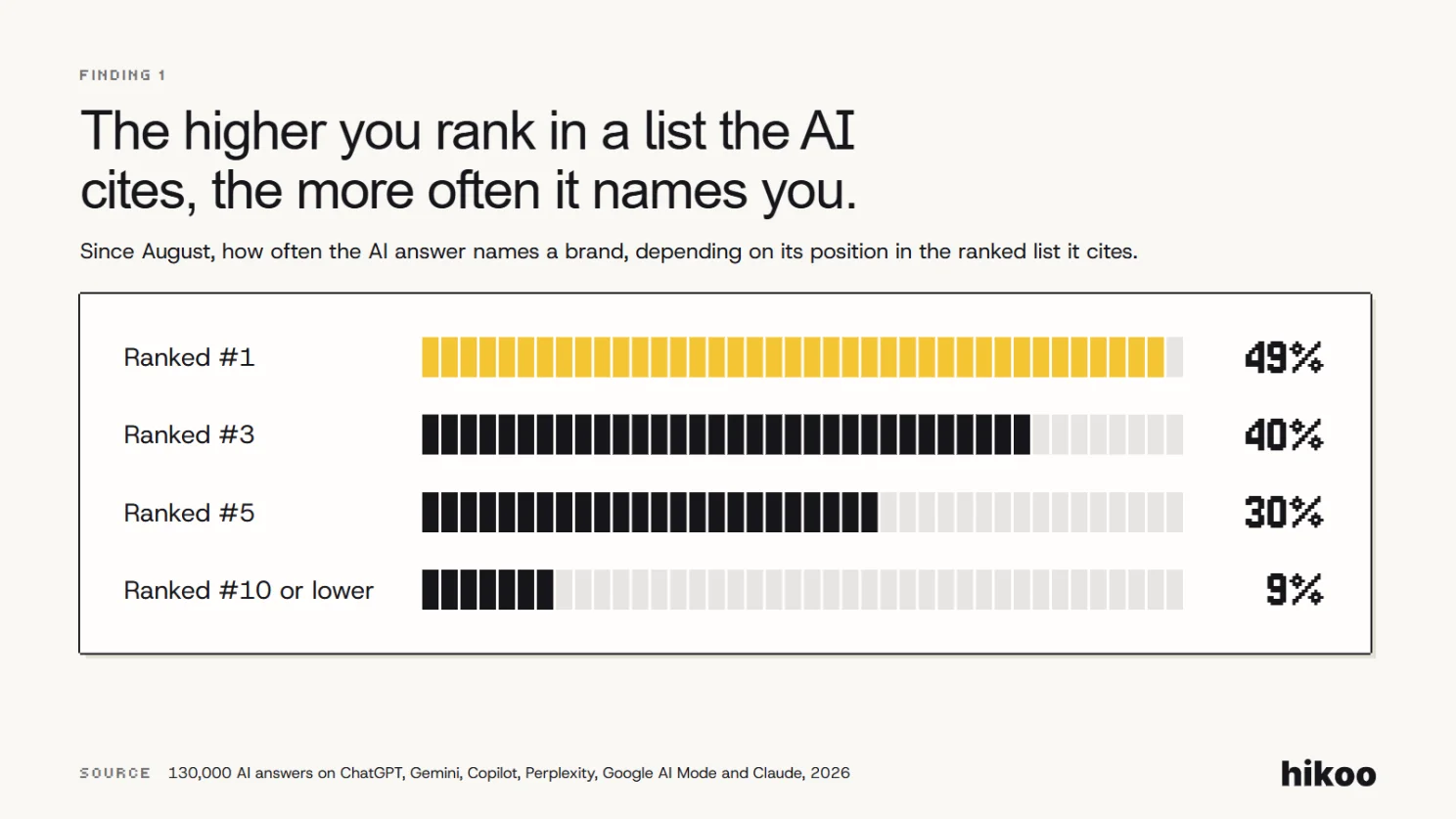
The brand ranked #1 gets named in 49% of answers, up from 40% between May and July, while a brand ranked #5 gets named in 30% of them (it was 23%) and a brand ranked #10 or lower in only 9% (it was 5%), which means the curve hasn't flattened at all and being #1 is still worth more than five times being #10.
The obvious pushback is that big brands get ranked first and get named simply because they're big, which is fair, so we compared each brand with itself by looking at the 352 brands that, since August, show up in the top 3 of some cited lists and at #6 or lower in others.
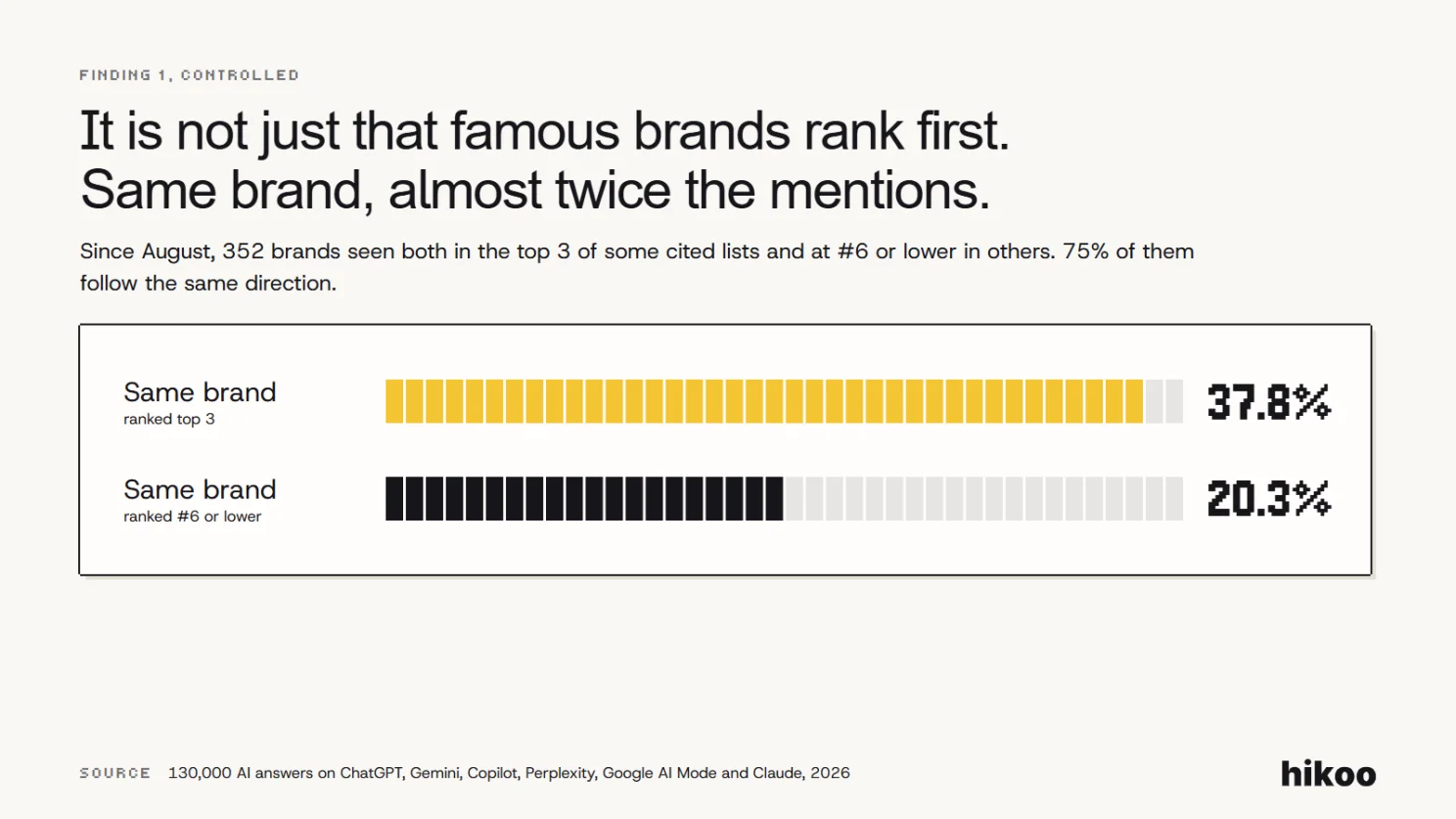
When they're in the top 3 they're named in 37.8% of answers, against 20.3% when they're at #6 or lower, and 75% of those brands go the same way, so with the same product and the same reputation, the only thing that changes is where a list put them, and that alone almost doubles their odds of being named.
Read also. Find the sources shaping LLM answers | Comparison pages
Finding 2
Do AI engines still penalize brands that rank themselves first?
Not since August 2026, except on Perplexity, since a brand that ranks itself #1 on its own website now gets named in 50.4% of the answers that cite its list, against 49.0% for a brand ranked #1 by an independent publisher, whereas it trailed by 12 points between May and July.
The next question was who actually writes these lists, so we matched each list's publisher against the brands it ranks, and it turns out that a third of the ranked lists cited since August (33.6%) were written by a vendor that appears in its own ranking, compared with 35.4% before August, so not much has changed on that side. Moreover, 78.5% of those vendors put themselves at #1, which won't surprise anyone.
We then compared two brands that are both #1 in a cited list, one that ranked itself on its own site and one that was ranked by an independent publisher, and between May and July the self-ranked one got named 12 points less often (31.6% vs 44.0%), so engines did discount it at the time. However, since August that gap has disappeared, with 50.4% for the self-ranked brand against 49.0% for the independently ranked one.
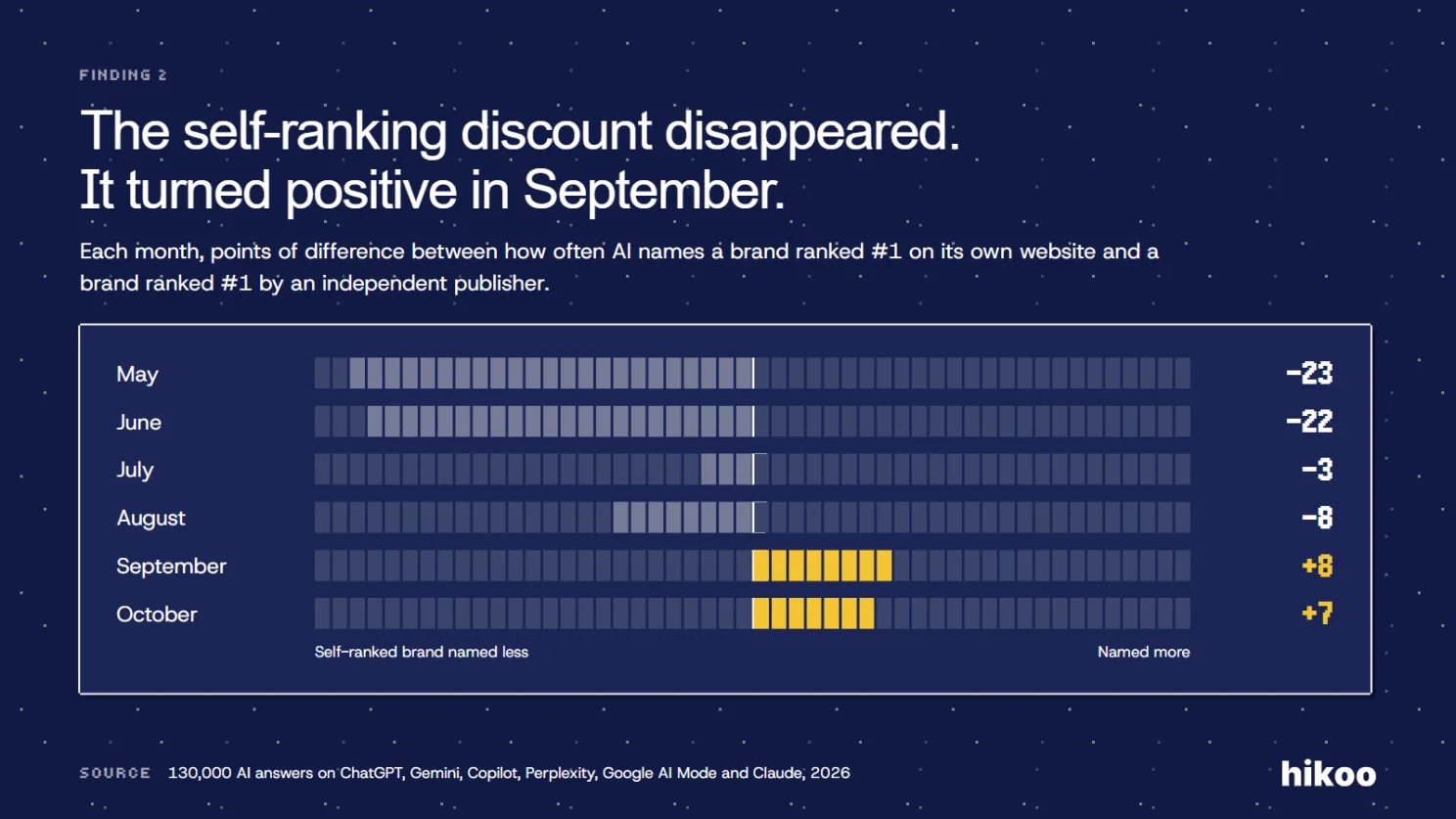
Month by month, the gap went from -23 points in May and -22 in June to +8 in September and +7 in October, and since we wanted to make sure this wasn't just our panel changing, we also checked the websites we followed across both periods, where the self-ranked #1 went from 31.9% to 50.8% and the independently ranked #1 from 43.3% to 47.0%, which tells the same story.
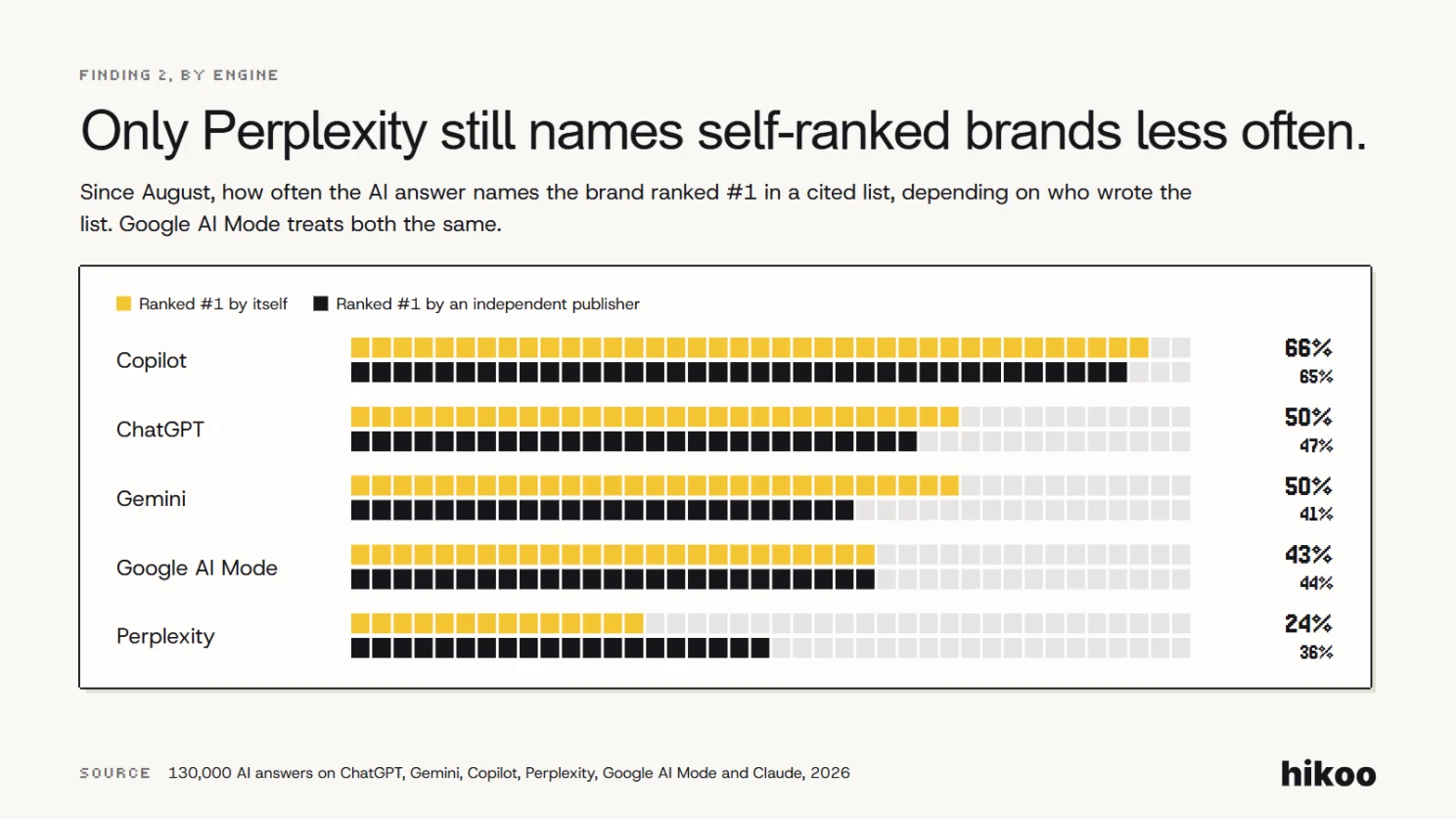
However, the picture isn't the same on every engine.
| Engine | Self-ranked #1 | #1 ranked by a third party |
|---|---|---|
| Copilot | 66% | 65% |
| ChatGPT | 50% | 47% |
| Gemini | 50% | 41% |
| Google AI Mode | 43% | 44% |
| Perplexity | 24% | 36% |
Perplexity is the only engine that still clearly holds it against you when you rank yourself first, whereas Gemini actually names you more often when you've ranked yourself #1 than when someone else did it for you, and Google AI Mode treats both cases the same once it cites a list, because its pullback is of a different kind, as it simply cites fewer ranked lists than before (more on that below).
And what happens the other half of the time?
Since a self-ranked #1 gets named in about half the answers that cite its list, we wanted to know what the AI does in the other half, so we looked at 6,272 cases since August and put them next to lists written by independent publishers.
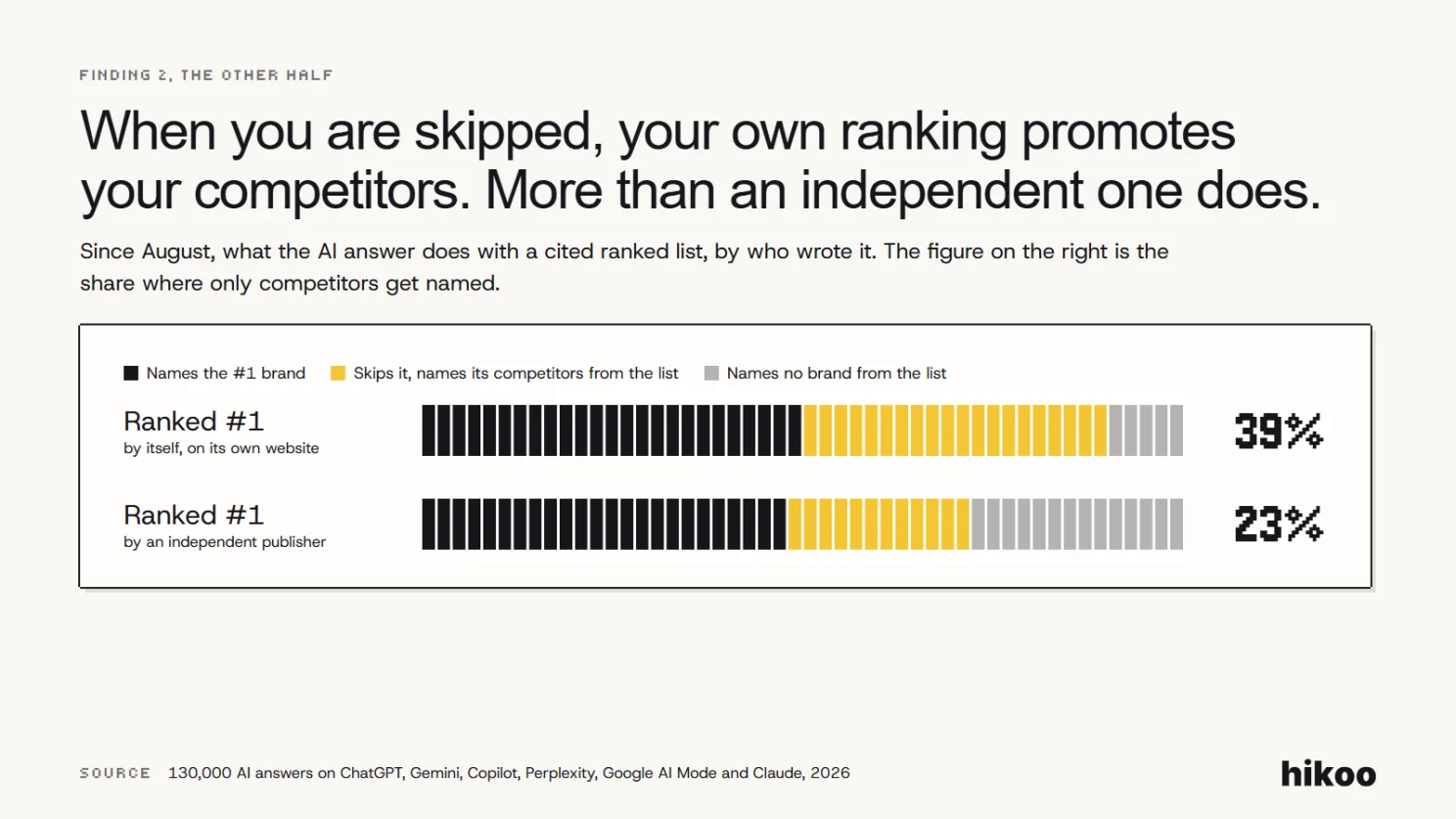
| What the answer does | List written by the #1 brand | Independent list |
|---|---|---|
| Names the #1 brand | 50% | 48% |
| Skips it, but names competitors from the same list | 39% | 23% |
| Names no brand from the list | 11% | 29% |
When the AI skips you, it still uses your list four times out of five, except that it takes your competitors from it rather than you, and on this point Lily Ray is right, since she found that in AI Overviews a self-promotional list helped competitors while leaving out its author in 70% of cases, and we see the same thing in 39% of cases overall and 52% on Google AI Mode.
Nevertheless, we don't draw the same conclusion from it, because an independent #1 gets skipped just as often, with a brand that ranks itself #1 on Google AI Mode left out of 57% of answers against 56% for a brand ranked #1 by someone else, which shows that ranking yourself isn't what gets you skipped, since being #1 doesn't guarantee anything, whoever wrote the list.
Read also. How to get cited by Perplexity | Compare your AI visibility with competitors
Finding 3
Does Google cite fewer ranked lists than the other engines?
Yes, and that's where the market has it right, since Google AI Mode is the only engine where ranked lists dropped as a share of cited pages, from 46% to 32%, while Gemini, Copilot and Perplexity cite more of them than before August 2026.
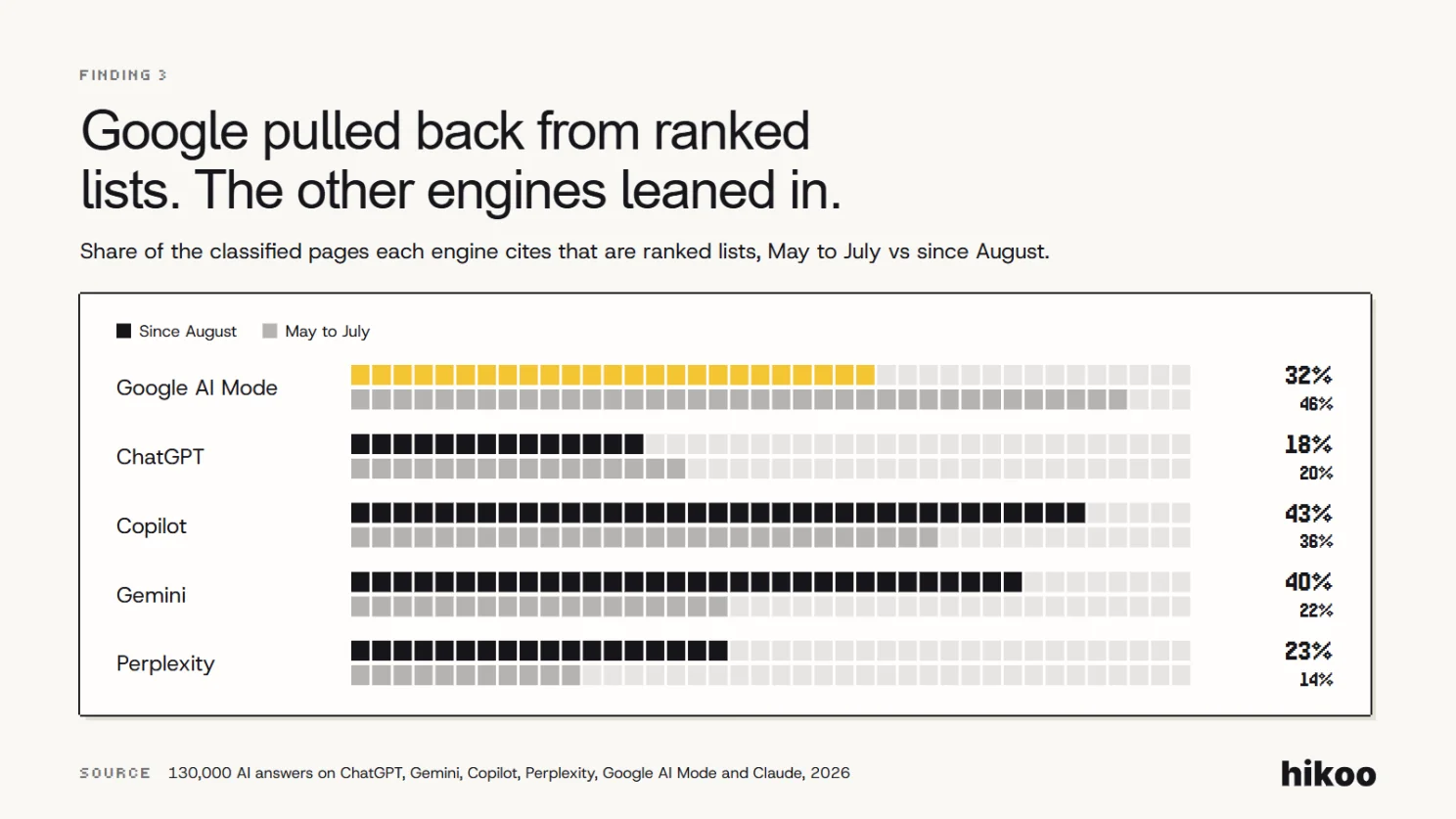
| Engine | May to July | Since August |
|---|---|---|
| Google AI Mode | 46% | 32% |
| ChatGPT | 20% | 18% |
| Copilot | 36% | 43% |
| Gemini | 22% | 40% |
| Perplexity | 14% | 23% |
Google AI Mode dropped 14 points, which lines up with what Lily Ray saw in AI Overviews, while ChatGPT barely moved and Gemini, Copilot and Perplexity now lean on ranked lists more than they did before August, so the idea that "AI stopped trusting listicles" holds for Google but not for the engines that write most AI answers today.
Read also. How to appear in AI Overviews | Which prompts your brand gets cited on
Frequently asked questions
What is a self-promotional listicle?
It's a "best of" list published by a brand that appears in its own ranking, usually at #1, since 78.5% of brands that rank themselves in their own list put themselves first, and these lists make up a third (33.6%) of the ranked lists AI engines have cited since August 2026.
What data is this study based on?
130,000 AI answers collected by Hikoo in 2026 on ChatGPT, Gemini, Copilot, Perplexity, Google AI Mode and Claude, for commercial prompts in six industries, with one answer per prompt, engine, market and day, comparing May to July with August to early November.
Should you still publish a comparison where you rank yourself #1?
Yes, as long as you know what it costs you, because since August 2026, ranking yourself #1 works about as well as being ranked #1 by someone else on ChatGPT, Gemini, Copilot and Google AI Mode but not on Perplexity, and in 39% of the cases where your list gets cited, the AI only names the competitors you put in it.
How much is the #1 spot in a list cited by AI worth?
A brand ranked #1 is named in 49% of the answers that cite the list, against 30% for #5 and 9% for #10 or lower, and for the same brand, dropping from the top 3 to #6 or lower cuts mentions from 37.8% to 20.3%.
Which AI engine cites fewer ranked lists?
It's Google AI Mode, where ranked lists fell from 46% to 32% of the classified pages it cites, while ChatGPT is stable and Gemini, Copilot and Perplexity cite more of them since August 2026.
What I'd take from this
First, go for the rank and not just the mention, because being #10 or lower is worth less than a fifth of being #1, so the work is to find which lists the engines already cite on your category's prompts and improve where you sit in them.
Second, don't drop your own comparison page yet, but be aware of what it costs you, because on ChatGPT, Gemini, Copilot and Google AI Mode ranking yourself #1 now works about as well as being ranked #1 by someone else, whereas on Perplexity it doesn't, so independent rankings still matter there, and in 39% of the cases where your list gets cited, the AI only names the competitors you put in it.
Third, treat Google separately, since it's the engine pulling back from ranked lists, so if Google AI Mode or AI Overviews are where your buyers are, your effort is better spent on independent reviews and comparison sites than on your own "best of" page.
If you have questions on the method, or a dataset you'd like us to cross-check, get in touch.
Sources
- 1Lily Ray Prediction: the next massive Google update is around the corner. Substack, October 4, 2026
- 2The Search Spot What 93,968 AI answers said about self-promotional listicles. Substack, Scrunch data, October 3, 2026
- 3Gabriel Toledano We analyzed 130,000 AI answers, and ranking yourself #1 in your own comparison still works, except on Perplexity, while Google cites fewer of them. LinkedIn, November 4, 2026
- 4Hikoo Ranked lists cited in AI answers. 130,000 AI answers on ChatGPT, Gemini, Copilot, Perplexity, Google AI Mode and Claude, May to early November 2026